
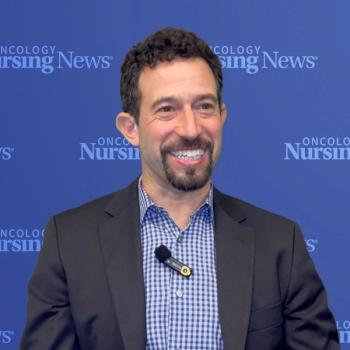
Toxicities related to Teliso-V are manageable for patients with c-Met overexpressing non-small cell lung cancer, according to Jonathan Goldman, MD.
Toxicities related to Teliso-V are manageable for patients with c-Met overexpressing non-small cell lung cancer, according to Jonathan Goldman, MD.
Patients with HR-positive, HER2-negative metastatic breast cancer should be consistently tested for ESR1 mutations to inform next lines of therapy.
A nurse practitioner gives her advice for managing adverse events during treatment with talquetamab for multiple myeloma.
The extended injection time for subcutaneous daratumumab in those with myeloma can serve as an opportunity for oncology nurses to check in with patients.
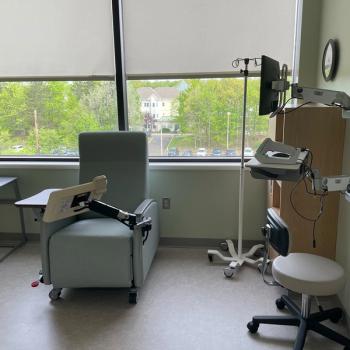
Infusion bays designed with nurse input provide patients the choice between privacy and community while allowing support from loved ones.
Subcutaneous daratumumab makes treatment a faster and more tolerable process for patients with multiple myeloma, according to an expert.
Nurse practitioners and physician assistants can advocate to play a number of roles in oncology research, including primary investigators.
Clinical trials can provide patients with myeloproliferative neoplasms expanded treatment options.
According to a nurse practitioner who works in myeloma research, nurses and APPs are responsible for much of the clinical work with patients involved in trials.
The intersection of cardiology and oncology is greater than nurses and providers may assume, explained 2 experts.
Danielle Fournier, DNP, APRN, AGPCNP-BC, AOCNP, discusses the role of oncology nurses in genomic testing.
Nurse practitioners should listen to patients’ concerns and be ready with questions when it comes to germline testing, according to an expert.
Oncology nurses and APPs can enhance patients’ comfort by counseling patients on what integrative care is and working to make those options accessible.
Using liquid biopsies to test for ESR1 mutations in breast cancer is more feasible for patients and has quicker turnaround times.

Practicing at top of licensure can create opportunities for oncology APPs to engage with patients and other providers in new ways.
Working with patients in new contexts can provide meaning for oncology PAs, potentially reducing burnout, according to Eric Tetzlaff, MHS, PA-C, DFAAPA.
Katherine Cohen, MSN, FNP-C, provided insights on what to consider when treating patients with HR+, HER2- breast cancer in the second line of treatment.
Documentation is especially important for nurse practitioners in cancer research and can lead to improved patient recruitment, says an expert.
Debriefing after patient loss, supporting patients at the end of life, and finding outlets outside of work can help oncology nurses avoid burnout.
The presence of biomarkers, even in small amounts, can shape the course of treatment for a patient, says Andy Guinigundo, MSN, RN, CNP, ANP-BC.
Jessie Desir, PhD, RN, AMB-BC, OCN, explained that comprehensive disease and treatment education are essential to adherence for patients with breast cancer.
Seth Eisenberg, ASN, RN, OCN, BMTCN, explained his research on a toilet cover for oncology nurses to potentially reduce exposure to infectious pathogens and hazardous drugs.
Oncology nurses and APPs provide support and can help to facilitate conversations with patients and families during end-of-life care.
In myeloma treatment, acute CRS is a common but treatable AE associated with CAR T-cell therapy and bispecific antibodies, according to a nurse practitioner.
Restaging cancer can be an unfamiliar space, but with more experience, APPs can rely less on MDs for guidance in such cases.
Working with multidisciplinary teams and educating patients are key to treating patients with cancer while navigating newly approved treatments.
Working with interdisciplinary teams and nurse navigators to coordinate care across specialties is a facet of oncology nursing that may be overlooked, says an expert.
Patricia Jakel, MN, RN, AOCN, emphasized that the bond oncology nurses have with patients with cancer necessitates honest and often difficult conversations.
Jessie Desir, PhD, RN, AMB-BC, OCN, discussed the need for awareness about cancer subtypes and their prevalence in certain populations.
