
Cassie A. Gray, MS, RN, OCN, CHPN, explains how early palliative care integration benefits patients with advanced cancer.
Cassie A. Gray, MS, RN, OCN, CHPN, explains how early palliative care integration benefits patients with advanced cancer.
Jeneth Aquino, DNP, FNP-BC, explains that using ctDNA to guide a patient’s next steps can provide clarity in the treatment process.
Heather Jackson, PhD, APRN, FNP-BC, NEA-BC, FAA-NP, explains the utility of a holistic approach to oncology care.
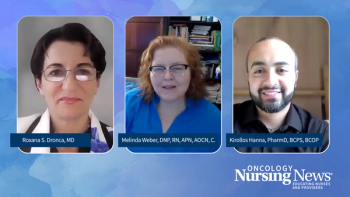
Panelists discuss how subcutaneous checkpoint inhibitors offer benefits through reduced wait times, potential for injection rooms or examination room administration, streamlined pharmacy workflows, improved patient quality of life by making them feel less like “cancer patients,” and opportunities for home-based care delivery in underserved areas.
Panelists discuss how intravenous (IV) administration of immune checkpoint inhibitors creates challenges, including infusion chair bottlenecks, lengthy multistep clinic visits, difficult venous access over time, and significant time burdens for both patients and health care systems.
Courtney Moore, APRN, FNP-C, OCN, discusses planning beyond first-line CDK4/6 inhibitors and supportive care strategies for patients with HR+/HER2– disease.
Subcutaneous daratumumab is well tolerated, but ongoing immune monitoring is key to managing infection risk in patients with multiple myeloma.

Leaders in oncology nursing and advanced practice spotlight the essential role of advanced practice providers in oncology.

Melissa Rikal, FNP-BC, AOCNP, explains how ctDNA can inform prognosis, monitor disease progression, and guide treatment decisions in oncology.

Caleb Raine, PA-C explains what BCMA is and why it is a common bispecific antibody target in multiple myeloma.

Scott C. Borinstein, MD, PhD, discusses how holistic and empathetic care defines pediatric oncology.
Courtney Moore, APRN, FNP-C, OCN, discusses how patient comorbidities and adverse effect profiles guide CDK4/6 inhibitor choice in the first-line setting.
Panelists discuss how practice improvements and patient resources can be implemented to empower both healthcare providers and ALK+ patients.
At SOHO 2025, Lorenzo Falchi, MD, highlighted the critical role of nurses in monitoring and educating patients on toxicities from novel lymphoma therapies.

Michelle Kirschner, MSN, RN, ACNP, APRN-BC, discusses how precision supportive care tailors interventions to patient needs.
Benjamin Besse, MD, PhD, shares AE management strategies for amivantamab/lazertinib in EGFR-positive NSCLC following CHRYSALIS-2 results.
Panelists discuss how they approach long-term monitoring and follow-up care for patients who have ALK-positive+ patients disease to maintain optimal outcomes on stable therapy.
Panelists discuss how practice improvements and patient resources can be implemented to empower both health care providers and patients who have ALK-positive disease.
Ghayas C. Issa, MD, MS, discusses key adverse events of menin inhibitors in NPM1-mutated and KMT2Ar AML.

Expert Kelsey Martin shares nursing insights on balancing glucose control and GI side effects when caring for patients on PI3K and AKT inhibitors.
Lisa Hwa Christenson, DNP, CNP, FAPO, shares best practices for monitoring CRS and ICANS with BCMA bispecific antibodies in community oncology.
Panelists discuss how patient education strategies support long-term treatment success, adherence, and shared decision-making.
Panelists discuss how they monitor and educate patients on ALK inhibitor side adverse effects while equipping nursing staff to manage toxicities proactively.
Karolina Faysman, NP, explains how step-up dosing is used to reduce CRS and ICANS with bispecific antibodies in multiple myeloma.
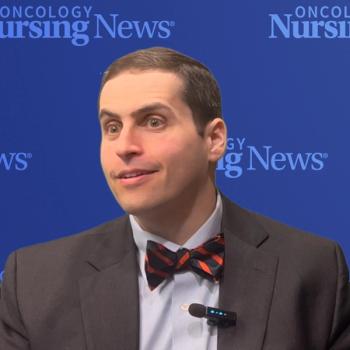
The role of nurses and APPs is crucial to ensuring patients with cancer can receive newer therapies, shares David A. Braun, MD, PhD.
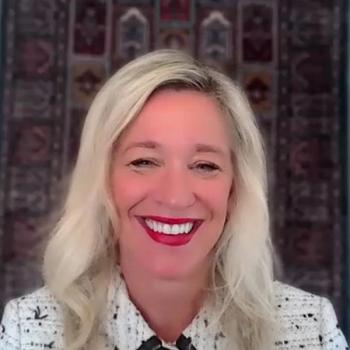
Nurse practitioner Beth Faiman shares strategies to reduce infection risk in patients receiving bispecific antibodies for multiple myeloma.

Catering supportive care to the individual being treated helps better meet the needs of each patient, says Michelle Kirschner, MSN, RN, ACNP, APRN-BC.
Lisa Hwa Christenson, APRN, DNP, CNP, FAPO, outlines best practices for safely transitioning patients with multiple myeloma on bispecific antibodies to community care.
Panelists discuss how patient-specific factors, including brain metastases and drug tolerability, influence front-line ALK inhibitor selection.
Panelists discuss how they manage adverse events associated with ALK inhibitors, comparing safety profiles and addressing unique patient concerns.
