Oncology nurses play a key role guiding patients about AI breast cancer risk assessment tools, dynamic re-testing, and individualized screening plans.
Ellery Palanuk, MSN, RN, CN-BN, explains how navigators rely on multidisciplinary teams and tumor boards as breast cancer treatment evolves.
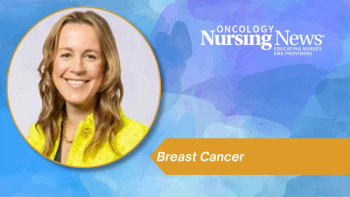
As targeted therapies and oral agents continue to reshape breast cancer care, no single clinician can master every new option, according to Ellery Palanuk, MSN, RN, CN-BN, a breast cancer nurse navigator at Compass Oncology, a practice in The US Oncology Network, in the Portland, Oregon, and Vancouver, Washington, area. In an interview with Oncology Nursing News, Palanuk said navigators can best serve patients by understanding enough to explain their care, answering what they can, and knowing when to bring in colleagues with more specialized expertise.
"I think the pace of change in breast cancer treatment is really incredible," Palanuk said. "There are so many new targeted therapies, oral medications, different treatment options."
Recent Oncology Nursing News coverage reflects that shift. In October 2026,
Palanuk, who has worked as a nurse in the Portland area for more than 10 years, said the navigator role does not require mastery of every agent.
"I'm lucky as a nurse navigator, I don't need to be the expert on every medication or every new treatment," she said. "I just need to understand enough to help my patients understand what's happening, answer the questions that I can for them, and know when and where to connect them for more specialized expertise."
Palanuk described relying on a broad team of specialists.
"I rely a lot on our multidisciplinary team that includes medical oncologists and APPs and also oral chemo nurses, our research team, patient education nurses and pharmacists," she said. "Everybody's going to bring a different level of expertise to that picture."
"One thing that I am passionate about is our internal tumor boards," Palanuk said.
The format allows the team to review "a patient who has a very complex case and bring it to the multidisciplinary care team, talk it through, hear the different perspectives, and come to a consensus about what makes the most sense for that individual patient," she explained.
"And I think there's a lot of value in doing that," she added. "And the patients really appreciate having their cases reviewed as well."
Palanuk summarized her role simply: "My job is just about kind of connecting the dots for people."