
Beth Faiman details the new IMS/IMWG consensus definition of cure for multiple myeloma, requiring 5 years of treatment-free remission.
Dana-Farber nurse practitioners outline ADC patient selection, sequencing, ILD surveillance, and patient education from JADPRO Live 2026.
Antibody-drug conjugates (ADCs) now span early-stage and metastatic breast cancer, and the oncology nurses and advanced practice providers (APPs) who give them carry much of the work of selecting patients, catching toxicities early, and preparing patients for treatment.
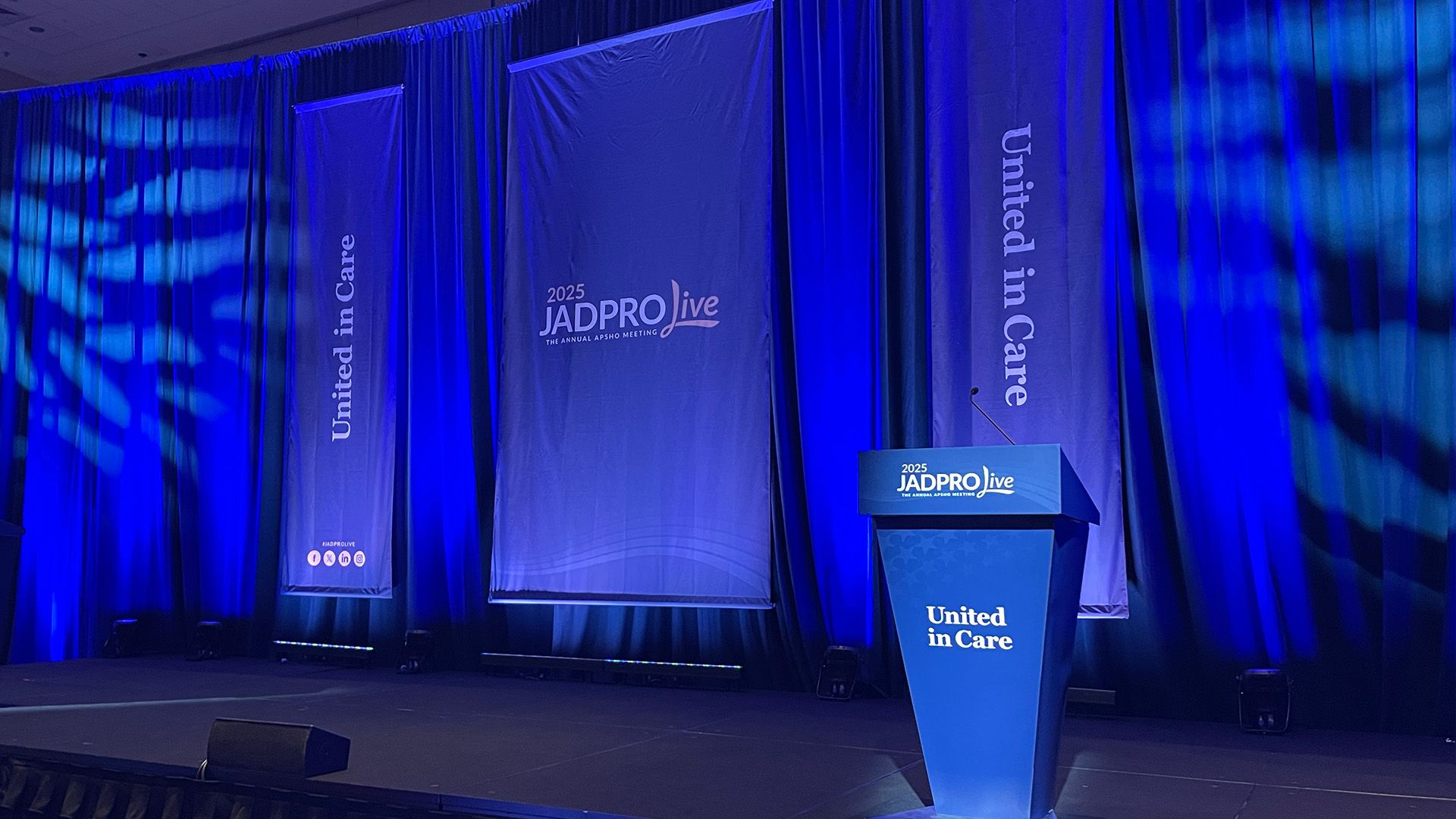
Kelly Fischer, MSN, FNP-BC, and Sarah Fischer, NP, both nurse practitioners in the Breast Medical Oncology Clinic at Dana-Farber Cancer Institute in Boston, Massachusetts, presented "Antibody-Drug Conjugates in Breast Cancer" at JADPRO Live 2026, held October 15 to 18 in Minneapolis, Minnesota.1 In an interview with Oncology Nursing News following the meeting, they described how their team selects patients, approaches sequencing when evidence is still evolving, and monitors for interstitial lung disease (ILD), neuropathy, cytopenias, and cardiac toxicity.
The session's learning objectives covered evidence-based use of ADCs in early-stage and metastatic breast cancer, guideline-informed sequencing and dose modification, patient counseling to support shared decision-making and adherence, and management of ADC-associated toxicities, including ILD, neuropathy, and cytopenias.1
Biomarker status drives the choice of agent. At Dana-Farber, patients who present with metastatic disease typically undergo genomic testing, often with the Guardant360 assay, according to Kelly Fischer. Hormone receptor and HER2 status come first.
For patients whose tumors are traditionally classified as HER2 negative, immunohistochemistry (IHC) scoring determines eligibility for fam-trastuzumab deruxtecan-nxki (T-DXd; Enhertu). T-DXd is approved for unresectable or metastatic hormone receptor (HR)–positive, HER2-low or HER2-ultralow breast cancer that has progressed on 1 or more endocrine therapies in the metastatic setting, based on the phase 3 DESTINY-Breast06 trial (NCT04494425), in which median progression-free survival (PFS) was 13.2 months with T-DXd vs 8.1 months with chemotherapy (HR, 0.64; 95% CI, 0.54-0.76).2
"That's a critical factor in determining what the treatment regimen will be for them," Kelly Fischer said of HER2 IHC scoring.
The ADC landscape has also moved earlier in the disease course and into the first line:
As more ADCs enter practice, patients may receive more than 1 over the course of metastatic disease, and the optimal order has not been established.
"This is a big question and still being looked at and studied," Sarah Fischer said. "So there's not a clear consensus on the appropriate way to do it, but our providers usually look at the different payloads."
She noted that a patient with TNBC who progresses on sacituzumab govitecan may go on to T-DXd, although, as she noted, both agents carry the same type of payload, a topoisomerase I inhibitor, and that some clinicians use chemotherapy between ADCs. The phase 2, noncomparative TRADE-DXd trial (NCT06533826) is evaluating Dato-DXd or T-DXd in patients with HER2-negative (HER2-low or HER2-0) metastatic breast cancer whose disease progressed on prior ADC therapy, with crossover to the other agent at progression.9
Kelly Fischer described a patient enrolled on TRADE-DXd at Dana-Farber whose disease progressed after about 3 cycles of T-DXd. "But she then switched immediately to Dato-DXd and she got about 8-ish months off of Dato, which was interesting," she said. "But we are looking more at sequencing because there's not really a clear consensus of what to do or what to use first or what to use next."
T-DXd carries a boxed warning for ILD and pneumonitis, and Dato-DXd labeling includes ILD/pneumonitis among its warnings and precautions.3,7 With T-DXd now used in curative-intent settings, Sarah Fischer emphasized surveillance imaging.
With T-DXd now used more often in the neoadjuvant and adjuvant settings, she said, "screening CT chest scans every 6 weeks [are] crucial because there are a lot of patients that are asymptomatic."
Early detection, she explained, creates the opportunity to hold treatment until ILD resolves and potentially resume the drug, which matters most when a tumor is visibly responding in the neoadjuvant setting. In the metastatic setting, staging scans are supplemented by patient reporting.
"We have the staging scans, but I also tell patients it's always, always report any changes in your breathing," Sarah Fischer said. "So you have to be really on top of any new dry cough, any changes."
Kelly Fischer added that the respiratory assessment requires context. A new, persistent dry cough without other upper respiratory symptoms warrants attention, which can be harder to sort out during influenza and COVID-19 season. Patients with lung metastases may already have dyspnea or cough at baseline.
"So I always say, you know, any change from your baseline respiratory status, please let us know," she said.
Before each cycle, the Dana-Farber team sees patients and reviews laboratory values because ADCs can cause myelosuppression and neutropenia. Mild nausea and fatigue are common across the class, and cytopenias occur most often with sacituzumab govitecan and T-DXd, according to
Neuropathy is an assessment point at every visit. "Neuropathy can occur with T-DM1 specifically, with that ADC. So, we do have to ask if they're having any numbness, any tingling," Kelly Fischer said. "That way, we can adjust the dosing because it actually can be a permanent side effect of therapy. So, we really need to intervene quickly and early."
Cardiac monitoring is also part of the workflow because some ADCs can cause left ventricular dysfunction, a warning on the T-DXd label.3 "So usually in the metastatic setting, we'll be getting echocardiograms every 6 to 12 months. And then in earlier stage settings, we will get echocardiograms usually every 3 months on these therapies," Kelly Fischer said.
Because patients receive a large volume of information before starting treatment, every patient at Dana-Farber is scheduled for a chemotherapy teaching session and receives written materials on the most common adverse effects and the treatment schedule. The team then reviews the information again at the visit before the first infusion.
1. Fischer K, Fischer S. Antibody-drug conjugates in breast cancer. Presented at: JADPRO Live 2026; October 15-18, 2026; Minneapolis, MN. Accessed October 23, 2026.
2. Steinzor P. FDA approves trastuzumab deruxtecan for HER2-low/ultralow breast cancer. AJMC. January 28, 2025. Accessed October 23, 2026.
3. FDA approves two separate indications for fam-trastuzumab deruxtecan-nxki for HER2-positive early-stage breast cancer. FDA. May 15, 2026. Updated May 16, 2026. Accessed October 23, 2026.
4. ONN Staff. FDA grants dual approval for T-DXd in HER2+ early breast cancer. Oncology Nursing News. May 16, 2026. Accessed October 23, 2026.
5. FDA approves T-DXd plus pertuzumab in metastatic HER2+ breast cancer. CancerNetwork. December 15, 2025. Accessed October 23, 2026.
6. FDA approves sacituzumab govitecan-hziy as monotherapy and in combination with pembrolizumab for first-line treatment of TNBC. The ASCO Post. June 2026. Accessed October 23, 2026.
7. FDA approves datopotamab deruxtecan-dlnk for unresectable or metastatic triple-negative breast cancer. FDA. May 22, 2026. Accessed October 23, 2026.
8. Attobrah Q. Datopotamab deruxtecan improves survival outcomes in advanced triple-negative breast cancer. Oncology Nursing News. April 30, 2026. Accessed October 23, 2026.
9. TReatment of ADC-refractory breast cancEr with Dato-DXd or T-DXd: TRADE DXd. ClinicalTrials.gov identifier: NCT06533826. Accessed October 23, 2026.
10. Rikal M. What toxicities are common for ADCs approved in breast cancer? Oncology Nursing News. August 19, 2025. Accessed October 23, 2026.