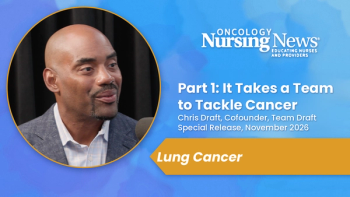
Former NFL linebacker Chris Draft shares how his late wife's lung cancer launched Team Draft and how nurses help families decode a new diagnosis.
Jan Franko, MD, PhD, explains how integrated teams of nurses, nurse practitioners, and navigators help patients get complex cancer care near home.
Patients with cancer are waiting longer to start treatment. A
For Jan Franko, MD, PhD, a surgical oncologist at Monmouth Medical Center, part of RWJBarnabas Health in Long Branch, New Jersey, the lesson is that "cancer doesn't travel well." Since joining the health system in October 2025 to help expand cancer services across its southern region, centered on Monmouth and Ocean counties, Franko has focused on delivering complex care closer to patients' homes.
"Really, being a patient for any condition, certainly for cancer, is almost like a full-time job," he said, echoing what oncology nurses recognize as
In an interview, Franko discussed the role of nurses and advanced practice providers (APPs) in that effort.
This interview has been edited for length and clarity.
That's a very complex question. But, focusing on the patients first is: How do we meet their needs, or needs which will be there in 5 minutes, or maybe in an hour, or next week? And we all know who spends the most time at the bedside of patients, other than family: It's nurses. They are definitely there all the time, and they have a special relationship. It's one of the most amazing professions, which existed before even physicians existed. So I think nurses are very instrumental — in fact, the fundamental connection between the patient and the health care system.
Many nurses proceed to be nurse practitioners. After years of clinical practice, they formalize a little bit more of the training and achieve an additional level of competency. And the reason why nurse practitioners are so necessary for integration is the care became very complex, because there are more options. Now, it doesn't mean more options is always better, but one has to choose, and the choice is not only at the beginning. It is at the beginning, but also later. Every day, whether chemotherapy is delivered, recovery is occurring, or treatment is just about to be started, there has to be somebody — often a nurse, almost always a nurse initially — who will examine the patient at the beginning and get the initial concerns.
So I think it's the creation of what we call integrated teams, so that a nurse has an easy way to reach a nurse practitioner and/or physician and back, and we trust our nurses, our nurse navigators. We have to create those systems because there is so much treatment which is available. But which one is the correct one? It is the team which is perfectly integrated, listens to the patients, knows what is available, and offers the best thing. We all together do it.
They all have extra training specific for oncology. They do have to maintain those credentials, which are formalized, and they also will work in a clinically integrated team. Again, another sterile word. What does it mean? That everybody knows who is a nurse in that team. Everybody knows who's the physician in that team, and they work every Monday through the next Sunday together. And over time, they gain so much experience and expertise together as a team that they can deliver that to the patients.
So I cannot emphasize 2 items more. The first is attention to the patient and their needs, seeking them and allowing them to be understood. And the second one would be the creation of the team. The physicians are so busy they cannot possibly spend a sufficient or desired amount of time with every patient, and the nurses and nurse practitioners are more important than ever.
They already do that because, at least in our institution, they work in teams, and it's expected of team leaders, especially physicians, to ensure that everybody has enough time to care for the patient. There's always pressure on that because there are never enough people working in health care. But it always can be and should be better. So by the creation and maintenance of those teams, and their expertise and their competencies, they create the trust as they deliver the care. Now, the trust has to be maintained, and that eventually is clearly evident once the people work for the patient's benefit.
The standards for nursing, or oncology nursing, are clearly nationally published, but then ongoing education within hospitals or hospital systems is what we do really well. There is an enormous amount of attention to continuity. It's not about becoming a physician or becoming a nurse or becoming a nurse practitioner. It's to actually maintain the competency and the skill as it is getting better every day, because there is more treatment available. So we offer those programs, we offer nursing credits, and we offer continuing medical education.
But even every tumor board — let's say the hematology tumor board, which occurs every Friday in our institution — provides an opportunity and information to the team. That information may be present in only one person, but they share it. They critically examine it: How is it applicable or beneficial, or perhaps not beneficial, for this patient? So it's ongoing work: integration, tumor boards, being together, and sharing information about the patients for their benefit.
1. Sakowitz S, Yamashita M, Donahue TR. National trends and predictors of waiting times for cancer surgery in the US. JAMA Surg. Published online August 12, 2026. doi:10.1001/jamasurg.2026.3212
2. Cancer surgery waiting times rising: what oncology nurses need to know. Oncology Nursing News. August 20, 2026. Accessed November 9, 2026.
3. Brink A. Opinion: oncology nurses can ease the burden of time toxicity in cancer care. Oncology Nursing News. February 26, 2025. Accessed November 9, 2026.