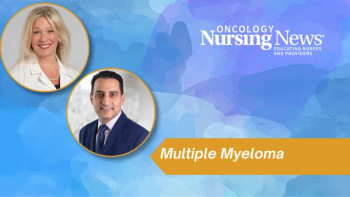
Beth Faiman, PhD, and Sikander Ailawadhi, MD, discuss clinical trials and nursing impacts of on-body isatuximab delivery in multiple myeloma.
Beth Faiman, PhD, and Sikander Ailawadhi, MD, discuss clinic workflows, safety checks, and at-home dosing potential for on-body isatuximab.
In the final installment of an Oncology Nursing News special three-part podcast series, Beth Faiman, PhD, MSN, APN-BC, AOCN, FAAN, FAPO, of Cleveland Clinic, and Sikander Ailawadhi, MD, of Mayo Clinic, analyzed the institutional integration, clinical workflows, and future care models for subcutaneous isatuximab-irfc (Sarclisa Escena). The discussion followed the U.S. Food and Drug Administration (FDA) approval of isatuximab-irfc administered via the CirCLIQ on-body delivery system (OBDS) across all approved multiple myeloma indications.
Indications include combination regimens with pomalidomide and dexamethasone (Pd) for relapsed or refractory multiple myeloma (RRMM), carfilzomib and dexamethasone (Kd) for RRMM, and bortezomib, lenalidomide, and dexamethasone (VRd) for transplant-ineligible newly diagnosed disease.
Institutional adoption of on-body delivery systems requires multidisciplinary coordination across nursing, pharmacy, and oncology teams. Faiman outlined the operational steps necessary to integrate the technology into hospital systems following its approval. "We've had to determine ... will this be added to our formulary, so we had to have meetings with our pharmacy and therapeutics committee," Faiman stated.
Faiman noted that healthcare teams must also update electronic health record ordering templates, establish hypersensitivity protocols, and align pharmacy dispensing processes.
Approval of subcutaneous isatuximab-irfc via OBDS was supported by the Phase III IRAKLIA trial (NCT05405166). In 531 patients with RRMM, subcutaneous isatuximab-irfc via OBDS demonstrated noninferior efficacy to intravenous isatuximab-irfc in combination with Pd, achieving an overall response rate (ORR) of 71.1% (95% CI, 65.2–76.5) versus 70.5% (95% CI, 64.7–75.9) in the intravenous arm.
Phase II supporting studies IZALCO (NCT05704049) and IsaSoCut (NCT05889221) demonstrated ORRs of 79.7% and 97.3%, respectively. Subcutaneous administration via OBDS yielded a 17-fold reduction in systemic administration reactions compared with intravenous infusion (1.5% vs 25.0%; P < .0001), with a median administration time of 13 minutes.
Highlighting protocol provisions in IRAKLIA that allowed healthcare provider-administered at-home dosing starting at Cycle 6 Day 15 for eligible patients without prior infusion reactions, Ailawadhi described home administration as a transformative shift. "I think this is the most exciting part of the study, in my mind, the possibility of doing at home administration," Ailawadhi emphasized. He noted that trial data confirmed equivalent efficacy, safety, and mechanics in home settings.
Comparing delivery modalities across the multiple myeloma treatment landscape, where isatuximab is currently the only anticancer agent approved via OBDS while other anti-CD38 therapies like daratumumab rely on manual subcutaneous pushes, Faiman emphasized the efficiency gains for clinical centers and patients. "This OBI offers the hope of eliminating the IV preparation, decreasing chair time because of a big difference in the IV administration over hours versus about the median 13-minute time," Faiman observed, concluding that home administration pathways could expand access for mobility-impaired or geographically distant patients.
Supported in part by Sanofi, content independently developed by OncLive and Oncology Nursing News. The opinions are those of the faculty and do not reflect those of any company that provided support. Before administration, please see package insert.