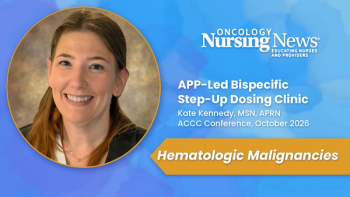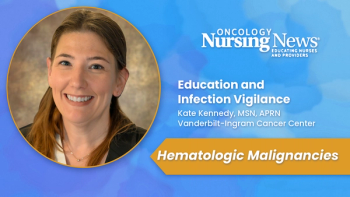
As bispecifics and cell therapies move outpatient, Kate Kennedy, MSN, APRN, says nurses and APPs should focus on education and atypical infections.
Interim AYA-NAV data show most navigation components reached young patients with cancer as designed, though full sessions lagged during treatment.
A tailored needs navigation intervention for adolescents and young adults (AYAs) with cancer who face financial hardship or unmet health-related social needs (HRSN) was largely delivered as designed, according to an interim fidelity analysis of the randomized AYA-NAV trial (NCT06950983) presented at the 2026 ASCO Quality Care Symposium.1 Delivering the full baseline navigation session proved harder during active treatment.
In prior work at Columbia, 74% of AYAs who responded to portal-based financial screening screened positive for financial hardship, with higher rates among male, Black, Hispanic, Asian and Spanish-speaking patients.2
Lead author Melissa P. Beauchemin, PhD, RN, CPNP, CPON, FAAN, assistant professor of nursing at Columbia University School of Nursing and scientific lead for cancer care delivery research with the CUIMC Minority/Underserved NCI Community Oncology Research Program at Herbert Irving Comprehensive Cancer Center, said her research centers on "how we can improve our care delivery system, particularly for young people with cancer."
"Much of that ends up focusing on financial hardship and health-related social needs, so difficulty affording food, housing, transportation, utilities that we know gets in the way of accessing and then staying engaged in care, both at initial diagnosis, during treatment and then into survivorship," Beauchemin said in an interview with Oncology Nursing News.
Her team has used the electronic health record and patient portal "to make sure that we're casting a wide net and making sure we're really understanding what the patients are experiencing, because we often assume and we don't know," she said.
Eligible patients were aged 15 to 39 years, receiving cancer treatment, spoke English or Spanish and screened positive for financial hardship (Comprehensive Score for Financial Toxicity [COST] score of 22 or less) or for HRSN. Participants were randomly assigned to usual care or AYA-NAV, which includes:1
Of 93 prescreened AYAs, 59 (63%) were eligible, and 55 (93%) of those consented and enrolled; 13 (24%) spoke Spanish. Thirty (55%) were randomly assigned to AYA-NAV, and 28 were included in the analysis. One participant withdrew before receiving any intervention, and 4 received the voucher without completing other components.1 Among eligible participants in the intervention arm:
Baseline components were completed within 4 weeks rather than 2, primarily because of logistical coordination. The authors concluded that AYA-NAV delivery meets acceptable fidelity benchmarks, especially for baseline components, and that close monitoring will support evaluation of preliminary efficacy, mid-study adaptations and larger-scale testing.1
Beauchemin, who described AYA-NAV as her primary intervention study, said engagement has differed by age.
"We're finding that they're engaged in these navigation interventions," she said. "The younger patients, I will say that adolescents are trickier because of that dyadic, you know, family household level, but we're learning a lot. And I think for the young adults, they're engaged, and we were really excited to see this engagement."
Navigation has improved uptake of other services in oncology; in one randomized trial,
The findings are interim and describe delivery of the intervention, not its effect on financial hardship, HRSN or clinical outcomes, which have not yet been reported. The analysis included 28 participants in the intervention arm. The 3-month check-in fell short of the fidelity target, and the navigation session met the target only when reduced-dose sessions were counted. The study is funded by the National Institute of Nursing Research.1
1. Beauchemin MP, Khurana R, Alvarado S, et al. AYA-NAV intervention fidelity assessment: a needs navigation intervention for adolescents and young adults with cancer. JCO Oncol Pract. 2026;22(suppl):259. Presented at: 2026 ASCO Quality Care Symposium; October 16-17, 2026; Boston, MA.
2. Beauchemin MP, Khurana RK, DeStephano D, et al. Implementing financial screening for adolescents and young adults treated in the outpatient oncology setting. JCO Oncol Pract. Published online June 9, 2025. doi:10.1200/OP-24-00868
3. Biese A. Navigation boosts cascade genetic testing in relatives of BRCA carriers. Oncology Nursing News. October 10, 2026. Accessed October 29, 2026. https://www.oncnursingnews.com/view/navigation-boosts-cascade-genetic-testing-in-relatives-of-brca-carriers
4. Dobkowski D. Informing patients with cancer on available resources can address financial toxicity. Oncology Nursing News. January 15, 2024. Accessed October 29, 2026. https://www.oncnursingnews.com/view/informing-patients-with-cancer-on-available-resources-can-address-financial-toxicity