Commentary|Articles|November 3, 2026

Inside an APP-Led Outpatient Clinic for Bispecific Step-Up Dosing

Author(s)Alex Biese
Fact checked by: By ONN Staff

Kate Kennedy, MSN, APRN, explains how Vanderbilt-Ingram's award-winning APP clinic moved bispecific step-up dosing out of the hospital.

An advanced practice provider (APP)–led clinic at Vanderbilt-Ingram Cancer Center in Nashville, Tennessee, moves bispecific antibody step-up dosing out of the hospital for patients who are willing and able, a model that earned a 2026 Association of Cancer Care Centers (ACCC) Innovator Award.1 According to ACCC, the program saved 137 of the 192 recommended inpatient days for monitoring.2

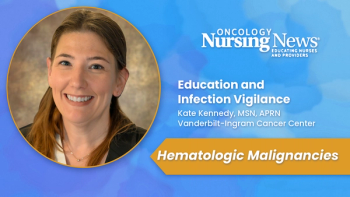
Kate Kennedy, MSN, APRN, ACNP-BC, AOCNP®, outpatient malignant hematology APP team lead at Vanderbilt-Ingram, presented the program at the ACCC 43rd National Oncology Conference, held October 21-23, 2026, in Boston, Massachusetts.3 She described the model in an interview with Oncology Nursing News.

Why move bispecific step-up dosing to the outpatient setting?

Bispecific antibodies such as teclistamab (Tecvayli) and talquetamab (Talvey) carry a risk of cytokine release syndrome (CRS) and neurotoxicity, which step-up dosing is designed to reduce.4 The accompanying monitoring guidance meant long admissions, Kennedy said.

"If you do it as quick as the label allows, you would have a patient in the hospital for at least 7 days to get their full [teclistamab] dose," she said.

The team also was not seeing the higher-grade CRS seen with chimeric antigen receptor (CAR) T-cell therapy, she noted. "Patients don't want to be in the hospital for 7 to 9 to 15 days while they're stepping up. So how do we move this safely to an outpatient situation?"

Why are APPs leading the clinic?

"We thought that we could make this pretty protocolized, which it is; it's very protocolized. There's very like, if X then Y, which lends itself well to like APP-led things," she said. The team has revised the protocol as it gained experience.

What does the patient experience look like?

A physician's treatment plan alerts the clinic's bispecific nurse coordinator, who gauges the patient's interest in, and ability to manage, outpatient dosing.

"Our goal is not to gatekeep any of these therapies," Kennedy said. "If the patient is unable to do it outpatient, we're not going to make them do it outpatient. We'll still admit that patient; they'll still get the therapy that they need."

The outpatient process includes:

  • A 1-hour APP education visit, in person or virtual, with the caregiver, covering CRS, neurotoxicity, and whom to call day or night.
  • Supportive medications, including pocket dexamethasone, antiviral and Pneumocystis jirovecii pneumonia prophylaxis, and antiemetics, brought to clinic on day 1.
  • A blood pressure cuff, pulse oximeter, and thermometer, with written call parameters set at about 20% off baseline vital signs and a temperature of 100.4 °F or greater.
  • Teach-back, home vital sign checks about every 4 to 6 hours, and immune effector cell–associated encephalopathy (ICE) assessments.
  • Daily visits through 48 hours after the first full dose, with local lodging for patients more than about 90 minutes away.

How is low-grade CRS managed?

"If they have grade 1 CRS, which would be just a fever, and they are non-neutropenic, we typically manage that outpatient," Kennedy said. "That's a change that happened as we got more comfortable with these drugs, and we realized that they really weren't progressing." Patients take their pocket dose, which she said is "8 milligrams of dexamethasone," and call the team if anything changes.

How does this fit the broader shift in bispecific care?

In prior coverage, Karolina Faysman, NP, of UCLA, noted that most patients are still admitted for step-up dosing, although centers with strong support systems are shifting outpatient.4 With teclistamab plus daratumumab and hyaluronidase-fihj (Darzalex Faspro) now approved as early as the second line in multiple myeloma, more patients may need step-up dosing.5

What are the key takeaways for oncology nurses?

  • Screen for willingness and ability; patients who cannot manage outpatient dosing can still be admitted.
  • Include caregivers in education and confirm understanding with teach-back.
  • Give written call parameters tied to each patient's baseline vital signs.
  • Ask caregivers to report word-finding difficulties between ICE assessments.
  • Set after-hours contingency plans before the first dose.

References

  1. 2026 ACCC Innovator Award winners: Vanderbilt University Medical Center/Vanderbilt-Ingram Cancer Center. Association of Cancer Care Centers. Accessed October 28, 2026. https://www.accc-cancer.org/about-accc/awards/accc-innovator-awards/2026-winners/vanderbilt-university-medical-center-vanderbilt-ingram-cancer-center
  2. Radwan R. An APP-led outpatient bispecific antibody clinic. ACCCBuzz. August 4, 2026. Accessed October 28, 2026. https://www.accc-cancer.org/view/an-app-led-outpatient-bispecific-antibody-clinic
  3. National Oncology Conference. Association of Cancer Care Centers. Accessed October 28, 2026. https://www.accc-cancer.org/events/national-oncology-conference
  4. Why step-up dose with bispecific antibodies? Oncology Nursing News. September 3, 2025. Accessed October 28, 2026. https://www.oncnursingnews.com/view/why-step-up-dose-with-bispecific-antibodies-
  5. Hoyt B. Nursing considerations for teclistamab/SC daratumumab's approval in second-line MM. Oncology Nursing News. March 10, 2026. Accessed October 28, 2026. https://www.oncnursingnews.com/view/nursing-considerations-for-teclistamab-sc-daratumumab-s-approval-in-second-line-mm

Related to this article