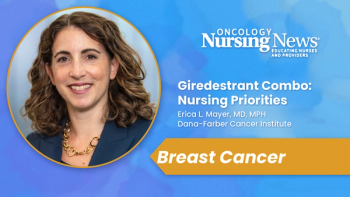
The evERA principal investigator explains ESR1 testing, bradycardia and stomatitis prevention, and oral adherence with giredestrant plus everolimus.
Erica L. Mayer, MD, MPH, explains what the all-oral giredestrant plus everolimus regimen asks of patients and oncology nurses between clinic visits.
The FDA approval of giredestrant (Wilserdly) plus everolimus (Afinitor), an all-oral regimen for ESR1-mutated, estrogen receptor (ER)–positive, HER2-negative advanced breast cancer, reflects a broader move away from infusion-based care that places new adherence, education, and monitoring demands on oncology nurses, according to Erica L. Mayer, MD, MPH, principal investigator of the phase 3 evERA Breast Cancer trial.1,2
In evERA, published in The New England Journal of Medicine, the combination reduced the risk of disease progression or death by 62% vs standard endocrine therapy plus everolimus in patients with ESR1-mutated tumors (HR, 0.38; 95% CI, 0.27-0.54), with median progression-free survival of 10.0 vs 5.5 months.2 The FDA approved the regimen on November 16, 2026, as
Mayer, director of breast cancer clinical research at Dana-Farber Cancer Institute in Boston, Massachusetts, said in an interview with Oncology Nursing News that the field's movement toward oral strategies is “highly favorable from both patient and provider point of view,” but that it changes the care relationship.
“It does require a partnership with patients about adherence to oral therapies and communication with the team about any emergent toxicities or other complications, as we may not be seeing patients as frequently in clinic as we might when we give infusional therapies,” she said.
“It is very important to instruct patients about how to take the medications, perhaps strategies to maintain adherence, such as using a pillbox or a home diary,” Mayer added. She also noted that oncology pharmacists can help improve adherence and make sure patients are fully educated about potential adverse effects.
Labeling-based counseling points include avoiding grapefruit and grapefruit juice, reporting symptoms of a slow heart rate such as dizziness or fainting, noting that the capsules contain lactose monohydrate, and using effective contraception during treatment and for 2 weeks after the last dose.1
Mayer agreed that recent drug development has emphasized reducing chair and clinic time. “One of the major goals in treating metastatic breast cancer and honestly in treating any advanced cancer is not only to help prolong survival but also to maintain or improve quality of life,” she said. “And I think in general, our patients vastly prefer staying out of medical settings and staying out of infusion units if they can.”
She expects the trend to continue. “So I do think in the future we will continue to see increasing strategies pivoting away from infusional-based therapies when possible, but requiring then new mechanisms for us to educate, monitor, and support patients as we are transitioning some of the responsibility of cancer care from our oncology teams to the patient directly,” Mayer said.
1. FDA approves Genentech's Wilserdly (giredestrant), a next-generation oral SERD, for ER-positive, ESR1-mutated advanced breast cancer. News release. Genentech. November 16, 2026. Accessed November 17, 2026. https://www.gene.com/media/press-releases
2. Mayer E, et al. Giredestrant plus everolimus in advanced breast cancer. N Engl J Med. 2026;395(13):1285-1298. doi:10.1056/NEJMoa2602457
3. ONN Staff.