At ASTRO 2026, Dr. Erica Braschi Jordan details toxicity tracking, physical therapy referral, and quality of life in proton regional nodal irradiation.
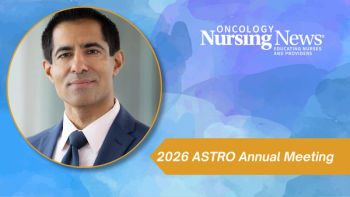
At ASTRO 2026, Suresh Rana details how AI-driven contouring accelerates care timelines, requiring rigorous team monitoring and early nursing input.
At the American Society for Radiation Oncology (ASTRO) 2026 Annual Meeting, radiation physics leaders highlighted the integration of artificial intelligence (AI) into daily treatment planning.
In an on-site interview with Oncology Nursing News, Suresh Rana, PhD, Assistant Vice President and Chief of Medical Physics at Lynn Cancer Institute, Boca Raton Regional Hospital, Baptist Health South Florida, detailed how AI-driven auto-contouring and automated plan checks are reshaping interprofessional workflows and care timelines.
Rana outlined the clinical implications of automated planning for frontline oncology nurses, radiation therapists, and physicists.
Integrating AI algorithms into radiation treatment planning streamlines organ-at-risk contouring, substantially accelerating clinical turnaround times. According to Rana, these technological advances directly benefit patients by expediting care delivery.
"With the AI-based contouring planning, that will definitely speed up the treatment journey for the patients when they come in the clinic," Rana stated. "So it will be a faster turnaround of the contouring and the planning, that means there will be more AI-based checks that are happening.”
As treatment planning cycles compress, oncology nursing workflows must evolve alongside physics and oncology schedules. Rana stressed that nurses must be actively integrated into these accelerated pathways.
To ensure seamless technological adoption, Rana advocated for involving nursing staff during initial software deployment rather than after protocols are finalized.
"My opinion [is] that they get also involved in the implementation process so whatever input they have we can implement way in the beginning rather than waiting until the end," Rana emphasized.
Furthermore, Rana clarified that while automation optimizes efficiency, human expertise remains indispensable.
"That doesn't mean that ... there will not be any human intervention," Rana noted. "So we want to make sure that they understand that the physicists, the dosimetrists, the therapists, the physicians who are involved in the process, they are actually monitoring so what AI is doing and we have double checks and balances."
Automated systems eliminate tedious manual steps while preserving rigorous multidisciplinary standards.
"Some of the tedious work will be removed by the AI, but at the same time we want to make sure the results that we're getting from the AI is high quality and monitored very rigorously by the multidisciplinary team," Rana concluded.