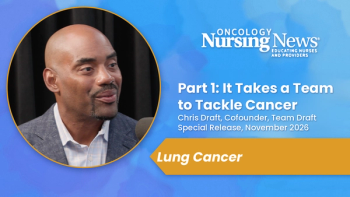
Former NFL linebacker Chris Draft shares how his late wife's lung cancer launched Team Draft and how nurses help families decode a new diagnosis.
In part 2, Team Draft cofounder Chris Draft explains how nurses can help patients with lung cancer feel seen, not blamed, and why their work matters.
Oncology nurses can counter lung cancer stigma by treating survivorship as the goal for every patient, regardless of smoking history, according to Chris Draft, a former NFL linebacker and cofounder of Team Draft, a lung cancer advocacy organization.1
In part 2 of a 2-part special release of the Oncology Nursing News podcast, Draft spoke about emotional support, the roots of lung cancer stigma, and what he wants nurses facing burnout to know.
Draft's wife, Keasha, died of lung cancer in December 2011, a month after their wedding.1 Rather than single out one nurse, Draft said she had a knowledgeable team in and outside the cancer center who answered the couple's questions, even when the honest answer was a plan B if a treatment did not work. Throughout, he said, "our journey was there was somebody always there," ready to act as a translator when the couple needed one.
Draft described a photo he took at a London museum while speaking at a UK nursing conference: a lung cancer image built around a cigarette, displayed next to an AIDS awareness ad saying that anyone can get AIDS. Historically, he said, the face of lung cancer has been a cigarette rather than a person who deserves compassion, because public messaging focused on prevention through smoking cessation, air quality, and workplace conditions.
"And so winning was people not getting it. So unfortunately it made it worse," Draft said. "Survivorship was seen as a failure of the system."
Recent Oncology Nursing News coverage has examined
Being seen and heard is only part of it, Draft said: "it's about us deciding that survivorship is the goal." Prevention, early detection, treatment, research, and survivorship can work together, he added. "That's deciding that regardless if you smoked or not, that survivorship is the goal and we're here for you."
Draft also urged clinicians to own the history of tobacco. He described nicotine addiction as on par with heroin and cocaine and said the tobacco industry targeted children, pointing to the 1998 Master Settlement Agreement, in which state and territory attorneys general settled lawsuits with the 4 largest US tobacco companies.3
For patients who still smoke, he said, the message is that the team will take care of them while helping them quit. For former smokers, he suggested starting with credit, because quitting is "probably the greatest accomplishment in your life."
He applies the same acceptance to his own loss: anyone can get lung cancer. "I don't like it," Draft said, adding that accepting it allows advocates to "move forward on the work of taking care of our people."
Drawing again on football, Draft said a quarterback cannot win alone, and neither can an offense without a defense or a team without the staff behind it. "You're appreciated. Thank you for what you do. You matter," he said. "Make sure that you lift up your other people too and realize that your job is important. Everyone's job is important."
1. Chris Draft. Team Draft. Accessed November 17, 2026.
2. How oncology nurses can dismantle lung cancer stigma. Oncology Nursing News. November 13, 2026. Accessed November 17, 2026.
3. The Master Settlement Agreement. National Association of Attorneys General. Accessed November 17, 2026.