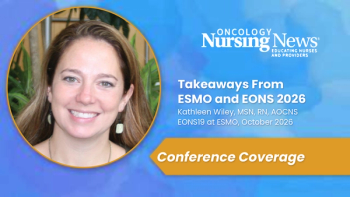
An ONS nursing practice leader shares takeaways from EONS19 at ESMO 2026, from workforce sustainability to new therapies and subcutaneous care.
Donna D. Catamero, ANP-BC, OCN, CCRC, says CAR T-cell and bispecific therapies have myeloma teams discussing cure, with nurses on the front line.
With CAR T-cell therapies and bispecific antibody combinations producing progression-free survival (PFS) curves that flatten over time, clinicians treating multiple myeloma are now asking how to define cure, according to Donna D. Catamero, ANP-BC, OCN, CCRC, who presented on new agents and sequencing strategies at the 10th Annual School of Nursing Oncology (SONO), held November 11, 2026, at the New York Hilton Midtown in New York City.1
Catamero is associate director of myeloma research at The Mount Sinai Health System and adjunct faculty at Mount Sinai Phillips School of Nursing in New York.1,2 In an interview with Oncology Nursing News before her 25-minute session, "Multiple Myeloma: New Agents and Sequencing Strategies," she said her area of expertise is multiple myeloma and that she specializes in clinical trials.1
During her on-stage presentation, Catamero put the shift in perspective for attendees, noting that overall survival was 3 to 5 years when she first began working in myeloma.”
"Now we're talking about progression-free survival, even in the newly diagnosed space, potentially up to 17 years," she said from the podium. Patients who are not cured, she added, are increasingly "not dying from their myeloma."
Catamero closed that portion of her remarks by looking ahead to the American Society of Hematology (ASH) Annual Meeting. "The ASH conference is next month, and there's more and more in this space, which I'm very excited about," she told the audience.
In her interview, Catamero described how newer therapies have changed expectations in the relapsed/refractory setting.
“Relapsed refractory setting, which historically patients have had poor outcomes, we're seeing progression-free survival that we have never seen before and patient outcomes to the point that we're now discussing how do we define cure," she said. "Because with CAR T therapies, bispecific combinations, we're seeing flattening of the curve. So our PFS is a nice flat line with some of these newer trials."
"Historically, we thought of multiple myeloma as being an incurable disease, chronic disease, but incurable," Catamero added. "And now, we're at the age of therapies where we can finally discuss curing patients."
That question has begun to take formal shape. At the International Myeloma Society (IMS) 2026 Annual Meeting, the IMS and the International Myeloma Working Group introduced a
Catamero said in the interview that the growing complexity of treatment places nurses at the center of care.
"The nurses are at the front line, they're at the bedside. They are administrating these novel therapies, they're managing the side effects, they're monitoring the side effects. They're usually the first ones, the first line of defense. Understanding these side effects are important," she said. "…So yes, conferences like this where nurses can get information on these novel therapies is really crucial because again, they're the first line of defense…and they usually field the most questions."
Catamero also stressed the importance of nurses understanding how these treatments work so that they can explain them clearly to patients and families.
Those responsibilities extend across the disease course, from frontline quadruplet regimens that require
1. 10th Annual School of Nursing Oncology (SONO): agenda. Physicians' Education Resource. Accessed November 13, 2026.
2. Donna D Catamero, NP. Mount Sinai. Accessed November 13, 2026.
3. Faiman B. IMS 2026: Beth Faiman details first consensus definition of myeloma cure. Oncology Nursing News. October 6, 2026. Accessed November 13, 2026.
4. Biese A. Frontline multiple myeloma care: clinical operations and nursing strategy. Oncology Nursing News. September 10, 2026. Accessed November 13, 2026.