At EONS 2026, a City of Hope nurse practitioner explains how shifting immunotherapy from infusion to injection can free nurse and chair time.
Suzanne E. Barron, CRNP, explains how education, premedication, and pharmacy coordination streamline intravesical gene therapy treatment days.
Patient education, anticholinergic premedication, and close nurse-pharmacy coordination are the pillars of an updated nursing workflow framework for nadofaragene firadenovec-vncg (Adstiladrin), the first FDA-approved intravesical gene therapy for adults with high-risk, Bacillus Calmette-Guérin (BCG)–unresponsive non–muscle-invasive bladder cancer (NMIBC) with carcinoma in situ (CIS), with or without papillary tumors. The framework was presented as a poster at the Society of Urologic Nurses and Associates (SUNA) Annual uroLogic Conference, held October 22 to 25, 2026, in Las Vegas, Nevada.1
The poster builds on a practical nursing guide first published in Urologic Nursing in spring 2025 and has been revised to reflect updated prescribing information, including an accelerated water-bath thawing option.1,2 Under the March 2026 label update, vials may be thawed outside the cardboard nest in a 25 °C water bath in approximately 25 minutes; previously described methods require approximately 3 to 5 hours outside the nest or 8 to 10 hours inside it at room temperature, or 11 to 13 hours inside the nest when thawed in the refrigerator.1-3
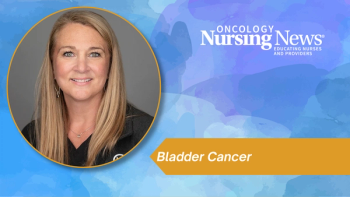
Oncology Nursing News spoke with Suzanne E. Barron, CRNP, a nurse practitioner and nurse manager in the outpatient urology clinic at Thomas Jefferson University Hospital in Philadelphia, Pennsylvania, and lead author of the poster, about the gaps that prompted the framework and how nursing teams can adapt it to their own practice.
The key takeaways are patient education, letting them know about the Adstiladrin workflow, making sure they're aware of potential side effects, trying to premedicate them with anticholinergics before they come in, because it is very irritating to the bladder, and then also letting them know about the thaw time—that there's going to be some waiting for the medication to be thawed.
At our institution, we don't right now have the water bath, but in some institutions [it] is approved for the water bath that will decrease the thaw time to 25 minutes. At our institution, it takes about 3 hours, because they come in, they get their urine checked, we make sure that they don't have any [nitrites] or signs of an infection or any symptoms before we thaw the medication. So it's a lot of patient education. And then also after they get the Adstiladrin, to make sure that they're adding either the bleach or the hydrogen peroxide to the toilets, like a half a cup, and letting that sit there for 15 minutes for 2 days.
I feel like the biggest thing is the patient education was really missing. We weren't really preparing them for what to expect. [It's] a new medication that's been out, I think, since 2022. I was [an] inpatient urology nurse practitioner before, so I just moved to the outpatient world, but I believe we were doing the research on it before it went to market.
So we were unfamiliar with the whole workflow of getting that patient education. We were missing that prescribing of anticholinergic[s], and patients were having a hard time holding it in their bladder. And also just making sure that they were aware that it was going to be a long visit; even though their appointment was at 9:30, they weren't going to just come in and get the medication and leave—that there is that [thaw] time. We were just really missing all that patient education.
At Jefferson, we use Epic Secure Chat[s]. As soon as the patient comes in, we're testing the urine, and we work with pharmacy to let them know where we are in the process, [that] the patient's asymptomatic. Also, the day before, I go over with the head oncology pharmacist that they're coming in for Adstiladrin, making sure that we have the doses even weeks in advance, that we have it ordered in. It is a process.
We are very fortunate here at Jefferson. We have [an] infusion center right above [us] and the pharmacists are very familiar with chemotherapies [and] oncology medications, so they've been super helpful, but it's just a really good communication between the nurses and the oncology pharmacists that we strive to maintain, so that way we know exactly when the medication is ready to come pick it up.
We talk it over with the patients before they come in, and then also our nurses are really great at discussing with them what it's going to look like at home for the next couple of days, that they are going to experience still some irritative [voiding] symptoms, to make sure that they understand the process of adding the half a cup of bleach—most patients have bleach at home—and letting it sit in the toilets for that 15 minutes and then flushing the toilet for the first 2 days.
And then also if they're [of childbearing] age, which most are not—they're mostly in their 70s—just to make sure that they're using contraception. And then also that they're aware of this is not just one and done. They still need their 3-month follow-up with the urologist for the surveillance to make sure that there is no recurrence. [They] may need another treatment in 3 months if there's no recurrence [so] that we can treat again in 12 weeks.
This transcript has been edited for clarity and length.