Opinion|Videos|June 2, 2025
Real-World Experience: The Efficacy and Tolerability of Oral Elacestrant for Patients with ESR1 Mutations
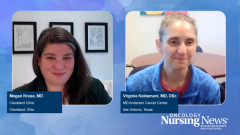
Author(s)Virginia Kaklamani, MD, DSc, Megan Kruse, MD
Panelists discuss how real-world studies have shown improved outcomes with elacestrant compared with the original EMERALD trial data, demonstrating that proper patient selection leads to better treatment responses.
Advertisement
Episodes in this series
Video content above is prompted by the following:
Clinical Brief: Real-World Evidence Supporting Elacestrant Use
Main Discussion Topics:
- Real-world outcomes exceeding clinical trial results (unusual finding)
- GUARDIAN database analysis: 6.4 months median time to treatment failure
- Komoda database: 6.8 months progression-free survival (9.4 months if fulvestrant-naive)
- Expert clinical experience aligning with real-world data
- Importance of appropriate patient selection for optimal outcomes
Key Points for Physicians:
- Real-world PFS (6.4-6.8 months) exceeds EMERALD trial results (3.8 months)
- Fulvestrant-naive patients show particularly strong outcomes (9.4 months)
- Early adopters report better results with refined patient selection
- Confirms benefit of using elacestrant in second-line for appropriate patients
- Real-world data validates subgroup findings from EMERALD
The real-world evidence conclusively demonstrates that proper patient selection based on EMERALD subgroup analyses results in significantly improved clinical outcomes compared with the overall trial population.
Advertisement
Related to this article
Lisa Carter-Bawa, PhD, MPH, APRN, explains how blame keeps patients from lung cancer care and how nurses can counter that stigma in the community.

At the 10th Annual School of Nursing Oncology, faculty said nurses need fast, disease-specific updates to educate patients and manage novel therapies.

Experts detail evidence for exercise, acupuncture, and mind-body care during radiation, and the knowledge and referral gaps that limit uptake.

Coral Omene, MD, PhD, discusses the clinical impact of breast cancer disparities and how oncology nurses can support diverse trial recruitment.
An ONS review presented at EONS19 outlines 7 system-level employer strategies to curb oncology nurse burnout and improve retention.
A Columbia nurse scientist shares her takeaways from the 2026 ASCO Quality Care Symposium, from geriatric assessment to care across the age span.
A patient, a caregiver, nurses, an NP, and an oncologist discuss rash prevention, dose holds, cost, and trial eligibility with oral daraxonrasib.
In a 117-patient cohort, 35% waited over 60 days for neoadjuvant chemotherapy, most often because of added workup, second opinions or comorbidities.
Advertisement
Advertisement