
Opinion|Videos|June 2, 2025
Exploring a Patient Case: Biomarker Testing After Progression and Discussing Treatment Choices With Your Care Team
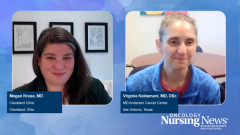
Author(s)Virginia Kaklamani, MD, DSc, Megan Kruse, MD
Panelists discuss how to communicate genomic testing results to patients and make shared treatment decisions, particularly when multiple targeted therapy options are available for patients with ESR1 and PIK3CA mutations.
Advertisement
Episodes in this series
Video content above is prompted by the following:
Clinical Brief: EMERALD Trial Insights for ESR1-Mutant Breast Cancer
Main Discussion Topics:
- Overview of EMERALD trial design and patient population
- Co-primary end points and efficacy outcomes for ESR1-mutant tumors
- Critical subset analyses identifying best responders (>12 months prior CDK4/6)
- Median PFS outcomes: 8.6 months versus 3.8 months in optimal patients
- Limited relevance of variant allele frequency (VAF) for treatment selection
Key Points for Physicians:
- Elacestrant approved specifically for ESR1-mutant metastatic breast cancer
- Prior CDK4/6 duration greater than 12 months predicts better response (8.6 versus 1.9 months PFS)
- Benefit maintained across visceral disease, multiple metastatic sites
- PIK3CA co-mutations do not negate elacestrant benefit
- VAF is not currently useful for treatment selection decision-making
The EMERALD trial established that patient selection based on endocrine sensitivity duration, rather than just mutation presence, optimizes treatment outcomes with elacestrant.
Advertisement
Related to this article

Dr. Andrew Pecora on leading the first IV oncolytic virus trial, building a top-50 cancer center, and using AI to fix the cost of cancer care.
In the phase 2 EVITA trial, vitamin C did not slow clonal growth but was linked to fewer serious adverse events and longer exploratory survival.
In observation of National PA Week, Moffitt PA Mark Honor discusses the expansion of APPs and key collaboration strategies for oncology nurses.
Beth Faiman details the new IMS/IMWG consensus definition of cure for multiple myeloma, requiring 5 years of treatment-free remission.
Oncology clinicians gathered to review relapsed CLL care options, CAR T-cell trial updates, and advanced practice provider roles.
At ASTRO 2026, Suresh Rana details how AI-driven contouring accelerates care timelines, requiring rigorous team monitoring and early nursing input.
At ASTRO 2026, Dr. Erica Braschi Jordan details toxicity tracking, physical therapy referral, and quality of life in proton regional nodal irradiation.

At ASTRO 2026, Dr. Mishaal Munir details how nurse-led triage workflows and prompt symptom escalations improve care for breast cancer brain metastases.
Advertisement
Advertisement
Trending on Oncology Nursing News
1
FDA Grants Accelerated Approval to Dostarlimab in dMMR Rectal Cancer
2
How AI Could Ease the Cost Crisis in Cancer Care
3
Anktiva Plus BCG: Telling Expected Immune Effects From Red Flags
4
Automated Breast Ultrasound Tied to Fewer False-Positives in Dense Breasts
5