Opinion|Videos|June 2, 2025
EMERALD Trial Results: What Prior CDK4/6i Duration Means for Treatment Success
Author(s)Virginia Kaklamani, MD, DSc, Megan Kruse, MD
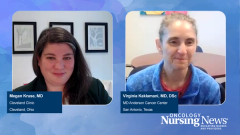
Panelists discuss how the EMERALD trial demonstrated elacestrant's efficacy in ESR1-mutated tumors, particularly in patients who had received CDK4/6 inhibitors for at least 12 months. This led to its FDA approval for this specific population.
Advertisement
Episodes in this series
Video content above is prompted by the following:
Clinical Brief: Elacestrant Subgroup Benefits and Safety Profile
Main Discussion Topics:
- Efficacy across different disease sites (bone-only versus visceral)
- Impact of tumor burden (multiple sites of metastasis)
- Co-mutation status (PIK3CA, p53) and treatment efficacy
- Safety profile focusing on gastrointestinal (GI) tolerability and lipid monitoring
- FDA recommendation for lipid profile monitoring requirements
Key Points for Physicians:
- Elacestrant efficacy maintained in visceral disease and high tumor burden
- Unexpected positive results even in p53-mutant tumors
- Less antiemetic use required compared with aromatase inhibitors
- New requirement: lipid profile before treatment and as needed thereafter
- Overall well-tolerated side effect profile with manageable GI symptoms
The comprehensive subset analyses support broad applicability of elacestrant in ESR1-mutant patients who demonstrate endocrine sensitivity, regardless of traditional adverse prognostic factors.
Advertisement
Related to this article
In the phase 2 EVITA trial, vitamin C did not slow clonal growth but was linked to fewer serious adverse events and longer exploratory survival.
In observation of National PA Week, Moffitt PA Mark Honor discusses the expansion of APPs and key collaboration strategies for oncology nurses.

Beth Faiman details the new IMS/IMWG consensus definition of cure for multiple myeloma, requiring 5 years of treatment-free remission.
Oncology clinicians gathered to review relapsed CLL care options, CAR T-cell trial updates, and advanced practice provider roles.
At ASTRO 2026, Suresh Rana details how AI-driven contouring accelerates care timelines, requiring rigorous team monitoring and early nursing input.
At ASTRO 2026, Dr. Erica Braschi Jordan details toxicity tracking, physical therapy referral, and quality of life in proton regional nodal irradiation.
At ASTRO 2026, Dr. Mishaal Munir details how nurse-led triage workflows and prompt symptom escalations improve care for breast cancer brain metastases.
ASTRO 2026 presenter Kayla Kafka-Peterson details an Adapt-Adopt-Build model to bridge global brachytherapy nursing gaps and standardize perioperative care.
Advertisement
Advertisement
Trending on Oncology Nursing News
1
Breast Cancer Awareness: An APN on Personalized Care and Survivorship
2
FDA Approves Atezolizumab Plus Chemo for Stage 3 dMMR Colon Cancer
3
Navigation Boosts Cascade Genetic Testing in Relatives of BRCA Carriers
4
Daily Symptom Shifts Linked to Quality of Life in Metastatic Breast Cancer
5