
Dr. Andrew Pecora on leading the first IV oncolytic virus trial, building a top-50 cancer center, and using AI to fix the cost of cancer care.
Elizabeth Lee, MD, shares that rinatabart sesutecan’s mechanism of action may allow more patients with advanced endometrial cancer to receive effective treatment.
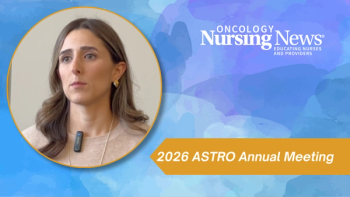
Updated data from cohort B2 of the phase 1/2 RAINFOL-01 trial (NCT05579366) demonstrate that patients with heavily pretreated, advanced endometrial cancer with indetectable folate receptor–alpha (FRα) may respond to treatment with rinatabart sesutecan (Rina-S), as Elizabeth Lee, MD, shared in an interview with Oncology Nursing News.
At a median follow-up of 1 year, Rina-S, an FRα-targeted TOPO1-inhibitor antibody-drug conjugate (ADC) elicited a 50.0% confirmed objective response rate, including 2 complete responses when treated with 100 mg/m2 every 3 weeks in patients whose disease progressed after platinum-based chemotherapy and an immune checkpoint inhibitor.1
Lee, an investigator in the trial who works in gynecologic oncology at Dana-Farber Cancer Institute in Boston, Massachusetts, explained that even patients with low or undetectable FRα levels derived benefit from the ADC, presenting the potential to meet unmet needs in this patient population.
We’re starting to understand that endometrial cancer harbors a number of cell surface markers, including [FRα], that are overexpressed in most cases, in addition to other protein markers. Where Rina-S is targeting [FRα], it makes sense on a biological level.
With Rina-S, if you want to dive right into the data, this is evolving from the ovarian cancer experience with mirvetuximab soravtansine-gynx (Elahere), and we’re bringing our knowledge, understanding, and the questions that have come from that experience over to endometrial cancer.
What we want to drill down to is, does the level of expression of the target—in this case, [FRα]—matter, or does it not matter? RAINFOL-01, the B2 cohort that was presented by [Noelle Cloven, MD,] at [the 2025 European Society for Medical Oncology Congress] intriguingly showed responses regardless of FRα expression. This is very important.
What we want to see are very high levels of activity, even down to minimal or potentially [undetectable] levels of FRα, at least based on the immunohistochemistry test that we have available at this time. How many more women will be able to access this type of therapy that’s very effective without having to meet very high levels of cut-off for that protein expression?
This transcript has been edited for clarity and conciseness.