

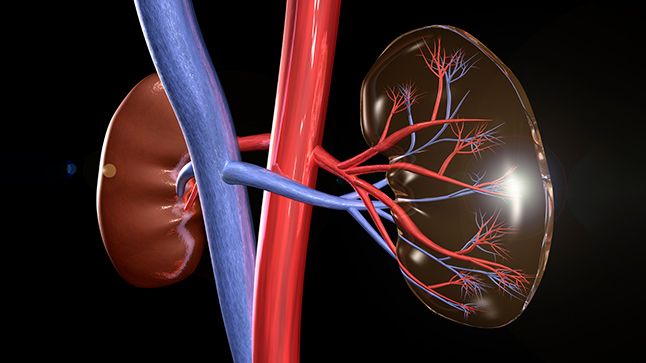

















































Patients with renal cell carcinoma (RCC) who were treated with tivozanib (Fotivda) experienced a 26% reduction in the risk of progression or death compared with sorafenib (Nexavar), according to results from the phase 3 TIVO-3 trial.
Patients with renal cell carcinoma (RCC) who were treated with tivozanib (Fotivda) experienced a 26% reduction in the risk of progression or death compared with sorafenib (Nexavar), according to results from the phase 3 TIVO-3 trial.
The FDA has granted the PARP inhibitor rucaparib (Rubraca) a breakthrough therapy designation for single-agent use in adult patients with BRCA1/2-positive metastatic castration-resistant prostate cancer (mCRPC) following at least 1 androgen receptor–directed therapy and taxane-based chemotherapy.

A new test that identifies which bladder cancer tumors will become invasive could help reduce health care costs and over-treatment in patients.

To determine what Americans know—and think they know—about prostate cancer, the PCF surveyed more than 2000 adults in the United States and uncovered some misperceptions that might prevent men who are at risk from accessing screening.

This letter from the Chairman and CEO of Oncology Nursing News gives an overview of the contents of the September 2018 print issue of the magazine.
Combining the PD-L1 inhibitor avelumab (Bavencio) with the VEGF inhibitor axitinib (Inlyta) significantly improved progression-free survival (PFS) compared with sunitinib (Sutent) in treatment-naïve patients with advanced renal cell carcinoma (RCC), according to findings from the phase III JAVELIN Renal 101 study.
A novel glutaminase inhibitor, CB-839, may provide a survival benefit in combination with cabozantinib (Cabometyx) by cutting off the energy supply to tumor cells in patients with metastatic renal cell carcinoma (RCC).
There are still no simple answers to the question of screening for prostate cancer.

African-American and Caucasian patients with metastatic castration-resistant prostate cancer (mCRPC) demonstrated similar overall survival (OS) rates, according to study results presented at the 2018 ASCO Annual Meeting.

Enfortumab vedotin, an antibody-drug conjugate, showed promise as a post-immunotherapy treatment of patients with locally advanced or metastatic urothelial cancer, according to Jonathan E. Rosenberg, MD.

The FDA has approved enzalutamide (Xtandi) for the treatment of patients with nonmetastatic castration-resistant prostate cancer (CRPC).

Patients with nonmetastatic castration-resistant prostate cancer experienced a 94% reduction in their risk of PSA progression following apalutamide (Erleada) treatment, according to a posthoc analysis from the phase III SPARTAN trial.

Sunitinib (monotherapy appeared noninferior to cytoreductive nephrectomy and adjuvant sunitinib, the current standard of care for patients with synchronous metastatic renal cell carcinoma, according to results from a phase III study presented at the 2018 ASCO Annual Meeting.
Researchers from the University of Texas MD Anderson Cancer Center in Houston, TX compared how various prostate cancer treatments compare on cost and adverse effects.

Mark J. Mann, MD, discusses the developing treatment landscape for patients with nonmetastatic castration-resistant prostate cancer.
The FDA has approved the combination of immunotherapy drugs nivolumab (Opdivo) and ipilimumab (Yervoy) as a frontline treatment for patients with advanced renal cell carcinoma (RCC).

The National Comprehensive Cancer Network (NCCN) has added apalutamide (Erleada) to its category 1 recommendations for the treatment of patients with nonmetastatic castration-resistant prostate cancer.
The FDA has approved a supplemental biologics license application to add a 4-week dosing schedule for nivolumab (Opdivo) across several of the PD-1 inhibitor’s indications.
Patients with nonmetastatic castration-resistant prostate cancer now have their first FDA-approved treatment. Apalutamide (Erleada) was approved based on the phase III SPARTAN trial in which apalutamide reduced the risk of metastasis or death by 72% in patients with nonmetastatic CRPC.

William C. Huang, MD, discusses the transition from open cystectomy to minimally invasive robotic-assisted surgery in the management of muscle-invasive bladder cancer.
Based on findings from the phase III LATITUDE trial, the Food and Drug Adminstration has approved abiraterone acetate (Zytiga) for use in high-risk patients with castration-sensitive prostate cancer.

The year 2017 saw significant advancements in the field of bladder cancer treatment. Five Food and Drug Administration (FDA) approvals for checkpoint inhibitors in both the first and second line setting opened up the immunotherapy landscape, and more develoments are on the way.

Cisplatin, a platinum-based chemotherapy agent that is used to treat testicular cancer, non-small cell lung cancer, bladder cancer, cervical cancer, ovarian cancer and head and neck cancer, has been found to cause a significant amount of hearing loss in patients, according to a recent article published in Nature Communications.
The FDA has granted a breakthrough therapy designation to the combination of pembrolizumab (Keytruda), a PD-1 inhibitor, and lenvatinib (Lenvima), a VEGF/FGF inhibitor, for the treatment of patients with advanced and/or metastatic renal cell carcinoma (RCC).

The FDA has granted a priority review to a new drug application (NDA) for apalutamide (ARN-509) for the treatment of patients with nonmetastatic castration-resistant prostate cancer (CRPC). Apalutamide is an oral androgen receptor inhibitor.