
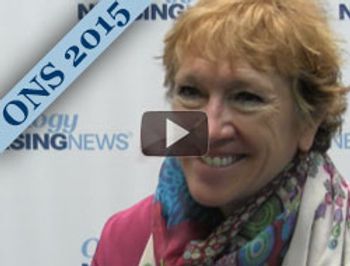
Kathy Wilkinson, RN, BSN, OCN, Manager, Cancer Research, Billings Clinic Cancer Center, discusses the role that nurse's play in clinical trials.
Kathy Wilkinson, RN, BSN, OCN, Manager, Cancer Research, Billings Clinic Cancer Center, discusses the role that nurse's play in clinical trials.
Do social media platforms like Twitter, LinkedIn, and Facebook represent an opportunity for oncology nurses to network and keep up with the latest in evidence-based practice, or are they a time-sucking nuisance, and even worse, a possible professional landmine?
While clinical trials remain a treatment option and play a significant role in furthering cancer research in treatment, symptom management and survivorship, less than 5% of patients participate in them, and 40% of patients report that they do not understand the idea of a clinical trial.

In a moving ceremony that drew tears from many in a crowd of nearly 1000, one outstanding nurse was recognized last night with CURE magazine's 2015 Extraordinary Healer Award for Oncology Nursing.
Using a color-coded, pocket-sized early warning scorecard has the potential to help nurses and other clinicians assess when cancer patients are deteriorating, and it's an intervention that could help avoid acute hospitalizations and even save lives, according to two clinical nurse specialists from Johns Hopkins who shared their experience with piloting an early warning tool.
Erica Fischer-Cartlidge MSN, CNS, CBCN, AOCNS, Clinical Nurse Specialist, Outpatient Breast Medicine Service, Memorial Sloan Kettering Cancer Center, discusses the difference between oral mucositis in patients receiving chemotherapy and patients taking an mTOR inhibitor.
Alice S. Kerber, MN, APRN, ACNS-BC, AOCN, APNG, Oncology Nurse Specialist, Georgia Center for Oncology Research and Education, explains how oncology nurses and genetic counselors will work together as the field of cancer genetics continues to grow.

Insomnia, restless leg syndrome, sleep apnea, and other sleep issues often affect quality of life in cancer patients, their caregivers, and survivors. Unfortunately, sleep complaints can often be overlooked by the medical staff or not mentioned by the patient.
Matthew Burke, MBA, RN, MSN, APRN-BC, Oncology Nurse Practitioner/Melanoma and Renal Cell Carcinoma, Yale New Haven Hospital, discusses managing immune-mediated adverse events (IMAEs)
Nicole Makris, BA, Emory University, discusses the findings that analyzed the HPV vaccination habits of women who have sex with women versus women who have sex with men.

Attendees at the 2014 ONS Annual Congress were encouraged to "Get Up, Get Moving" by recommending physical activity to improve patient outcomes.

Archana Ajmera, RN, MSN, WHNP-BC, ANP-BC, nurse practitioner, University of California, San Francisco, Helen Diller Family Comprehensive Cancer Center, discusses stomatitis prevention during everolimus/exemestane treatment for metastatic breast cancer.

Nearly half of cancer patients do not discuss sexuality with their healthcare providers, but that doesn't mean it isn't a concern for them.
Advances in precision medicine for the treatment of melanoma include novel small-molecule inhibitors targeting signal transduction pathways in BRAF and NRAS mutations and cutting-edge drugs in the area of immune-modulation, whereby the patient's own immune system is mobilized to attack the tumor.
Gwen Wyatt, PhD, RN, Professor, College of Nursing, Michigan State University, discusses a study that looks at acupressure to aid in relieving persistent cancer-related fatigue in breast cancer survivors.

With an increasing number of cancer therapies being delivered orally, the importance of adherence continues to grow, and efforts to adapt adherence programs from other conditions like HIV could lead to better outcomes.

Effectively communicating with patients about what to expect before and after cancer treatment is an essential element of patient care.
Denise Fleming, RN, BSN, OCN, University of California Davis Health System, Comprehensive Cancer Center, discusses the idea of a pre-treatment education phone call to patients scheduled to receive their first chemotherapy regimen in an outpatient facility.

Oncology practitioners and patients are increasingly looking to holistic interventions, such as aromatherapy, healing touch, guided imagery, and massage, to improve patient outcomes.
Oncology nurses attending today's keynote at the 2014 ONS Annual Congress received a rousing call to action from speaker Devon Harris, who told a packed arena at the Anaheim Convention Center that recognizing and deploying their own considerable leadership skills can reap manifold benefits for their patients, their peers, and their practices.

Carol Cannon, RN, BSN, OCN, Oncology Program Specialist, Nurse Oncology Education Program, Austin, Texas, discusses the importance of exercise and diet for cancer patients and how nurses can approach the subject.
Anne Kolenic, RN, BSN, OCN, University Hospitals Seidman Cancer Center, Cleveland, Ohio, discusses a pilot study that examined novice nurses' end-of-life communication skills while measuring their confidence levels on the subject.
The 39th Annual ONS Congress opens in Anaheim May 1 with an array of presentations and interactive programs aimed at offering attendees practical tips and tools they can use right away in their practices.

Each year, the Oncology Nursing Society (ONS) Annual Congress showcases leading nursing research to advance evidence-based practice, and this year's meeting is no exception.