
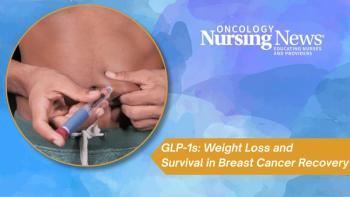
Experts explore the clinical promise, nursing implications, and access barriers of GLP-1s in cancer care.
Experts explore the clinical promise, nursing implications, and access barriers of GLP-1s in cancer care.

FDA approves subcutaneous isatuximab-irfc for multiple myeloma indications, offering an efficient delivery alternative to intravenous administration.
FDA approves Ennumo (pegfilgrastim-pccg), a biosimilar to Neulasta, providing a new option for oncology nurses to manage chemotherapy-induced neutropenia.

Dr. Rodney Haring discusses the 2026 AACR Cancer Disparities Report and the critical role of oncology navigators in tribal and rural health equity.
ESMO GI 2026 data show patients under 50 receive more aggressive therapy yet face poorer survival, suggesting EOCRC is a distinct biological entity.

Study finds 86.5% of gastric/GEJ patients completed surgery after neoadjuvant chemo, significantly improving survival over those who did not.

Long-term data show watch-and-wait is viable for rectal cancer, with most regrowths salvageable despite adverse baseline MRI features.

Melissa Baker discusses SOPs in transplant care, gene therapy for sickle cell, and the essential role of nurses in clinical strategy and care planning.
A real-world study presented at ESMO GI shows fruquintinib is effective in mCRC, with the best outcomes in the third-line setting.

Oncology nurse Kerry Mann details the protocols and patient-centered strategies for bringing advanced precision medicine to local community clinics.

Pamela Plasket, RN, discusses the evolving role of oncology nurses as lung cancer patients survive longer on advanced therapies like BiTEs.

Oncology nurse navigator Diane Stanaway discusses photosensitivity, new sunscreen innovations, and debunking common myths for patients and survivors.
Maite San Miguel and a new survey highlight how specialized training and clinical autonomy are vital for optimizing multiple myeloma outcomes.
The FDA approved Tregzi, a precision-engineered cell therapy, to improve chronic GVHD-free survival in adults undergoing allogeneic transplant.

PROSPER data reveal that mogamulizumab provides rapid, sustained relief from skin symptoms and improves sleep for patients with MF and SS.
The FDA approved Azurity’s Aprepitant Injectable Emulsion, a polysorbate-80-free, ready-to-use IV option for preventing chemotherapy-induced nausea.

New research finds younger generations age faster biologically, increasing risks for early-onset lung, colorectal, and other solid tumor cancers.

Oncology nurse Diane Stanaway offers essential sun protection strategies as NJ prepares for the heat of the 2026 World Cup and rising skin cancer rates.
The FDA approved the BESREMi Pen for polycythemia vera, offering a simplified self-administration option to improve patient adherence and care.
Rita M. Jakubowski, NP, explains how multidisciplinary age-friendly assessments and the CHARM study improve outcomes for older transplant patients.

Dr. Sonja J. Hughes discusses managing GI toxicities and the need for research regarding GLP-1 use among breast cancer patients and survivors.

Diane Stanaway, MSN, RN, highlights the importance of long-term skin protection for oncology patients during high-exposure events like the World Cup.

Nicholas Hornstein, MD, PhD discusses ctDNA in colorectal cancer, the INTERCEPT-TT trial, building Northwell's GI oncology program, and what better drugs will look like.
FDA approves sacituzumab govitecan-hziy as monotherapy and with pembrolizumab for first-line treatment of advanced triple-negative breast cancer.
The FDA approved palbociclib (Ibrance) for maintenance in HR+/HER2+ metastatic breast cancer after induction therapy, based on the PATINA trial.
Dr. Sriram Machineni explains why GLP-1 medications help manage cardiovascular health and inflammation in breast cancer survivorship.

Christina Klawitter explores the evolving role of oncology research nurses, highlighting the importance of pre-planning and interdisciplinary teamwork.

Teddi Mellencamp highlights the vital bond and advocacy of oncology nurses during the 2026 Extraordinary Healer awards ceremony in San Antonio.

Oncology nurses can guide patients through the rationale and implications of this decision.
Christina Klawitter, MSN, RN, OCN, discusses how meticulous pre-planning and team delegation optimize safety and patient care in clinical trials.