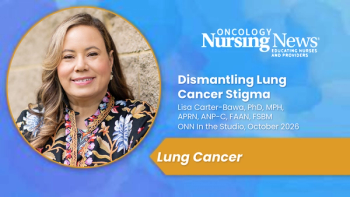
Lisa Carter-Bawa, PhD, MPH, APRN, explains how blame keeps patients from lung cancer care and how nurses can counter that stigma in the community.
Lisa Carter-Bawa, PhD, MPH, APRN, describes how AI could flag patients eligible for lung screening and why nurses must stay the human in the loop.
Artificial intelligence (AI) may help find patients eligible for lung cancer screening whose smoking histories are poorly documented in the electronic health record (EHR), but nurses must remain the human in the loop and developers must check whose data trained their models, according to Lisa Carter-Bawa, PhD, MPH, APRN, ANP-C, FAAN, FSBM, director of the Cancer Prevention Precision Control Institute at the Hackensack Meridian Center for Discovery and Innovation and deputy associate director for community outreach and engagement at Georgetown Lombardi Comprehensive Cancer Center, in an October 2026 interview with Oncology Nursing News.
“The best treatment that we have for lung cancer is actually early detection,” Carter-Bawa said, because finding disease at stage 1 opens far more treatment options than finding it at stage 3 or 4. According to the American Lung Association, the 5-year survival rate is 65% for lung cancer diagnosed at an early stage vs 10% for late-stage disease.1
She suggested that nurses use each new drug approval as an opportunity to link back to screening and to educate the broader public, not only people who are eligible. “We have this general awareness in the public about mammography and breast cancer screening, and I would like to see that for lungs,” she said. The person a nurse speaks with may not be eligible, she added, but their spouse or grandmother may be.
She suggested that nurses use each new drug approval to link back to screening and to educate the broader public. “We have this general awareness in the public about mammography and breast cancer screening, and I would like to see that for lungs,” she said. The person a nurse speaks with may not be eligible, but their spouse or grandmother may be.
Identifying who is eligible remains a central challenge, Carter-Bawa said, because smoking status and pack-years are “not always accurately recorded” in the EHR. In one study of patients referred for screening, pack-year history in the medical record was discordant with the history obtained during a shared decision-making conversation in 96.2% of cases (230 of 239).2
“You could leverage AI to identify screening-eligible people within your EHR,” she said, noting that AI could also support some of the outreach. “If you don’t know who the person is, you don’t even know how to reach out.”
“I am not a big proponent of AI replacing everything because I think the human connection is so incredibly important,” Carter-Bawa said. Nurses are the ones “that are going to be able to communicate empathically with the individual.” That view aligns with
Large language models are trained on existing evidence, “whether it’s good or bad,” and that evidence reflects disparities in who is represented, Carter-Bawa said. “If AI is being trained on a majority, there are people who are not represented in that training data. And so it’s going to potentially widen the disparities in some areas.”
Such bias has been documented: a widely used algorithm that relied on health costs as a proxy for health needs rated Black patients at the same risk as healthier White patients.4 Carter-Bawa urged developers to examine their training data and to rectify inequities “before going any further.”
1. State of Lung Cancer: key findings. American Lung Association. Updated February 5, 2026. Accessed November 2, 2026. https://www.lung.org/research/state-of-lung-cancer/key-findings
2. Modin HE, Fathi JT, Gilbert CR, et al. Pack-year cigarette smoking history for determination of lung cancer screening eligibility. Comparison of the electronic medical record versus a shared decision-making conversation. Ann Am Thorac Soc. 2017;14(8):1320-1325. doi:10.1513/AnnalsATS.201612-984OC
3. Kosko K. AI is at the door: should oncology nurses let it in? Oncology Nursing News. February 23, 2026. Accessed November 2, 2026. https://www.oncnursingnews.com/view/ai-is-at-the-door-should-oncology-nurses-let-it-in-
4. Obermeyer Z, Powers B, Vogeli C, Mullainathan S. Dissecting racial bias in an algorithm used to manage the health of populations. Science. 2019;366(6464):447-453. doi:10.1126/science.aax2342