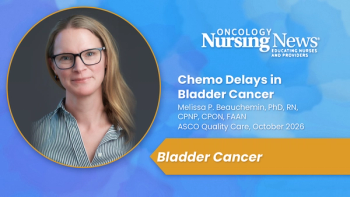
In a 117-patient cohort, 35% waited over 60 days for neoadjuvant chemotherapy, most often because of added workup, second opinions or comorbidities.
A Columbia nurse scientist shares her takeaways from the 2026 ASCO Quality Care Symposium, from geriatric assessment to care across the age span.
Effective cancer treatments and evidence-based assessments are only as good as the care delivery systems that bring them to every patient, according to Melissa P. Beauchemin, PhD, RN, CPNP, CPON, FAAN, who shared her takeaways from the 2026 ASCO Quality Care Symposium, held October 16 to 17 in Boston and online.
Beauchemin, assistant professor of nursing at Columbia University School of Nursing and scientific lead for cancer care delivery research with the CUIMC Minority/Underserved NCI Community Oncology Research Program at Herbert Irving Comprehensive Cancer Center, attended the meeting virtually and was an author on 3 posters at the symposium, including the interim fidelity analysis of AYA-NAV, a needs navigation intervention for adolescents and young adults (AYAs) with cancer that she leads.1
Beauchemin pointed to a session that used geriatric assessment in older adults with cancer as an example of the care delivery gap.
"They were specifically talking about the geriatric assessment and often how we know what we're supposed to do, and unfortunately, we don't do it," Beauchemin said in an interview with Oncology Nursing News. "Sometimes that, I think, makes people upset to hear, but I think that's one of the problems that we have, and that's sort of the care delivery gap, right?"
She said that gap is why ASCO Quality Care is one of her favorite meetings. "Most of the people there are really thinking about, OK, we have really incredible treatments now, but not everybody is getting them," she said. "And we're not still seeing both the amazing outcomes for everybody, but also the equitable outcomes for most people."
ASCO guidelines recommend geriatric assessment for adults aged 65 years and older who are receiving systemic cancer therapy,2 and randomized data from Supriya Mohile, MD, MS, and colleagues showed that providing oncologists with geriatric assessment–guided interventions reduced serious toxicity in older adults with advanced cancer.3 Nurses have been described as central to
"There's been great data supporting that…and still we don't do it," Beauchemin said. "And just this simple assessment can then help prevent catastrophic outcomes, falls, other toxicity in cancer treatment."
Beauchemin, a pediatric oncology nurse practitioner for more than 15 years, said the speaker made the point that the lesson extends beyond geriatrics to AYAs and pediatric patients, who are often part of complex home settings that include parents and siblings.
"How do we take what we know is evidence-based and bring it into the clinical care setting that is already quite busy?" she said. "I was happy to hear that thread of conversation."
She noted that financial hardship was the dominant thread at last year's meeting and said the topics the symposium covers are consistently relevant and timely, particularly as new therapies raise their own delivery challenges. In pediatric oncology, for example, blinatumomab (Blincyto) is given by continuous infusion.
"We're trying to figure out…what's going to happen when you have a family who lives 6 hours from an institution and there isn't a home care clinic, but the child needs to get 30 days of continuous infusion," she said. "These lessons, I think, were really translatable across the age span, for really all patients and many caregivers, too."
Beauchemin's posters addressed several of those delivery questions. A qualitative study led by her PhD student found that fertility preservation decisions among young women with breast cancer are made under time pressure and continue to affect patients in survivorship.5 A retrospective analysis she coauthored found that 35% of patients with muscle-invasive bladder cancer waited more than 60 days for neoadjuvant chemotherapy, mostly because of care-coordination factors.6 And in AYA-NAV, most navigation components reached participants as designed, although full-dose navigation sessions were harder to deliver during active treatment.1
"We're finding that they're engaged in these navigation interventions," she said of AYAs, adding that adolescents are "trickier because of that dyadic, you know, family household level, but we're learning a lot."
1. Beauchemin MP, Khurana R, Alvarado S, et al. AYA-NAV intervention fidelity assessment: a needs navigation intervention for adolescents and young adults with cancer. JCO Oncol Pract. 2026;22(suppl):259. Presented at: 2026 ASCO Quality Care Symposium; October 16-17, 2026; Boston, MA.
2. Dale W, Klepin HD, Williams GR, et al. Practical assessment and management of vulnerabilities in older patients receiving systemic cancer therapy: ASCO guideline update. J Clin Oncol. 2023;41(26):4293-4312. doi:10.1200/JCO.23.00933
3. Mohile SG, Mohamed MR, Xu H, et al. Evaluation of geriatric assessment and management on the toxic effects of cancer treatment (GAP70+): a cluster-randomised study. Lancet. 2021;398(10314):1894-1904. doi:10.1016/S0140-6736(21)01789-X
4. Fischer L. Geriatric assessments help guide meaningful cancer treatment. Oncology Nursing News. August 15, 2023. Accessed October 29, 2026. https://www.oncnursingnews.com/view/geriatric-assessments-help-guide-meaningful-cancer-treatment
5. Algave M, Junak S, Schnall R, Beauchemin MP. Exploring fertility preservation decision-making among female AYAs with cancer: a qualitative study. JCO Oncol Pract. 2026;22(suppl):152. Presented at: 2026 ASCO Quality Care Symposium; October 16-17, 2026; Boston, MA.
6. Wooster M, Kulkarni A, Raghunathan RR, et al. Reasons for delay in receipt of neoadjuvant chemotherapy in patients with muscle invasive bladder cancer. JCO Oncol Pract. 2026;22(suppl):178. Presented at: 2026 ASCO Quality Care Symposium; October 16-17, 2026; Boston, MA.