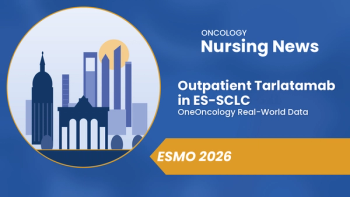
Among 90 patients with ES-SCLC, all CRS in the outpatient cohort was grade 1, and no patient in any care model was readmitted.
Lisa Carter-Bawa, PhD, MPH, APRN, explains how nurses can counter lung cancer fatalism by pairing honesty with hope and using teach-back.
Oncology nurses can counter the fatalism that has long surrounded lung cancer by pairing honesty with hope, partnering with patients on their goals, and confirming understanding with teach-back, according to Lisa Carter-Bawa, PhD, MPH, APRN, ANP-C, FAAN, FSBM.
Carter-Bawa, director of the Cancer Prevention Precision Control Institute at the Hackensack Meridian Center for Discovery and Innovation and deputy associate director for community outreach and engagement at Georgetown Lombardi Comprehensive Cancer Center, spoke with Oncology Nursing News in October 2026 at MJH Life Sciences studios in Cranbury, New Jersey.
“I like to tell people that this is not your grandfather’s lung cancer because we have so many treatments that if we can catch lung cancer early through screening, we can cure or significantly extend someone’s life,” Carter-Bawa said.
The US Preventive Services Task Force first recommended annual low-dose CT screening for people at high risk in 2013, and in 2021 expanded eligibility to adults aged 50 to 80 years with a 20 pack-year smoking history who currently smoke or quit within the past 15 years.1 Even so, only 18.2% of eligible individuals were screened in 2022, according to the American Lung Association.2
Carter-Bawa estimated that less than 10% of the roughly 15 million eligible people in the United States even know screening exists. “That’s not on them, that’s on us for not doing everything that we could to increase awareness,” she said. She has
“I personally think that honesty and hope can live in the same sentence. They’re not opposites,” Carter-Bawa said. Many patients still hear a lung cancer diagnosis as a death sentence, a belief she traced both to the limited treatment options of the past and to tobacco-related stigma. Nurses, she said, are “in such a unique position to dismantle that stigma by giving both hope and honesty.”
Carter-Bawa cautioned against paternalistic encounters in which patients are simply told what will happen. A patient whose goal is to attend a granddaughter’s wedding next year is in a different place than one who wants every available treatment, she explained. “If you don’t invite the person into that conversation, you don’t know that. So then you don’t know how to empathically respond to that.”
The teach-back method asks patients to state in their own words what they need to know or do about their health.4 “If the patient can’t teach it back to me, then I have not done my job well,” Carter-Bawa said, calling the approach “so simple, but it’s an underused kind of tool that we have.”
She paired teach-back with plain language. “You’re not dumbing it down. You’re making it accessible for people,” she said, adding that plain language “level sets between the nurse or the medical professional and the patient.”
1. US Preventive Services Task Force; Krist AH, Davidson KW, Mangione CM, et al. Screening for lung cancer: US Preventive Services Task Force recommendation statement. JAMA. 2021;325(10):962-970. doi:10.1001/jama.2021.1117
2. State of Lung Cancer: key findings. American Lung Association. Updated February 5, 2026. Accessed November 2, 2026. https://www.lung.org/research/state-of-lung-cancer/key-findings
3. Dobkowski D. Empathetic conversations with patients may alleviate lung cancer screening disparities. Oncology Nursing News. February 2, 2024. Accessed November 2, 2026. https://www.oncnursingnews.com/view/empathetic-conversations-with-patients-may-alleviate-lung-cancer-screening-disparities
4. Use the teach-back method: tool 5. In: Health Literacy Universal Precautions Toolkit. 3rd ed. Agency for Healthcare Research and Quality. Accessed November 2, 2026. https://www.ahrq.gov/health-literacy/improve/precautions/tool5.html
5. Altidor A. Improving patient education on medication toxicities in oncology. Oncology Nursing News. March 24, 2026. Accessed November 2, 2026. https://www.oncnursingnews.com/view/improving-patient-education-on-medication-toxicities-in-oncology