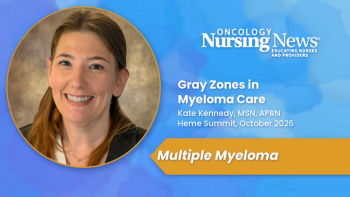
At the 2026 National Summit on Hematologic Cancers, Kate Kennedy, MSN, APRN, flagged decisions where guidelines give nurses and APPs little direction.
Among 90 patients with ES-SCLC, all CRS in the outpatient cohort was grade 1, and no patient in any care model was readmitted.
Tarlatamab-dlle (Imdelltra) was administered and monitored in community oncology infusion centers with no readmissions, and all cytokine release syndrome (CRS) events in the outpatient cohort were grade 1, according to a retrospective analysis of 90 patients with extensive-stage small cell lung cancer (ES-SCLC) treated at OneOncology partner practices. Care settings were not randomly assigned. The data were presented as a poster at the 2026 ESMO Congress in Madrid, Spain.1,2
Investigators reviewed electronic medical records of patients with ES-SCLC who started tarlatamab, a bispecific T-cell engager targeting DLL3 and CD3, between May 2024 and December 2025. Thirty patients were included in each of 3 care models:1
Patients in the outpatient model received dexamethasone premedication and intravenous fluids, and nursing staff monitored them in the infusion center for 4 to 8 hours after the step-up doses.1
Across the full cohort, any-grade CRS occurred in 46% of patients, and grade 3 or higher CRS occurred in 1%. Any-grade immune effector cell–associated neurotoxicity syndrome (ICANS) occurred in 14%, with grade 3 or higher ICANS in 2%.1
Rates by care model were:1
Three patients (3%) required intensive care unit–level care. No patient in any cohort was readmitted for any cause, and 1 patient, in the hybrid cohort, discontinued tarlatamab because of CRS.1
Brain metastases were present in 67% of the hybrid cohort, 50% of the outpatient cohort, and 57% of the inpatient cohort. Liver metastases were present in 77% of the hybrid cohort and 50% of each of the other 2 cohorts.1
In an exploratory analysis, high metastatic burden and liver or brain metastases were more common among patients who developed CRS or ICANS. The authors described these findings as hypothesis-generating given the small sample and concluded that "outpatient and hybrid tarlatamab administration was feasible."1
"Baseline patient characteristics and disease burden may help inform selection of patients for outpatient monitoring," they wrote.1
"The real-world results give us greater confidence that tarlatamab can be delivered outside the traditional inpatient setting in appropriately selected patients," lead author Trevor Feinstein, MD, of Piedmont Cancer Institute, said in a news release.1
"This study is an important demonstration of the feasibility of administering outpatient tarlatamab in community oncology practices," said coauthor Wade Iams, MD, MSCI, of Tennessee Oncology.1
In September 2026, the FDA approved a label update that shortened recommended monitoring after the cycle 1 day 1 and day 8 doses from 22 to 24 hours to 6 to 8 hours from the start of infusion, with a patient assessment the day after each of those doses. Patients should remain within 1 hour of an appropriate health care setting, accompanied by a caregiver, for 48 hours after those infusions. Monitoring after the cycle 1 day 15 dose and in later cycles was unchanged, and the boxed warnings for CRS and neurologic toxicity, including ICANS, remain.3,4
Tarlatamab received
The OneOncology analysis was retrospective and nonrandomized, included 30 patients per care model, and relied on medical record documentation to capture adverse events. Funding was not reported in the release.1
1. Real-world data from OneOncology practices show tarlatamab can be administered safely in the outpatient community oncology setting. News release. OneOncology. October 27, 2026. Accessed October 28, 2026.
2. Feinstein T, Raff L, Kristalyn M, et al. [Abstract title not reported in release]. Poster presented at: ESMO Congress 2026; Madrid, Spain. Poster 6409FPN.
3. FDA approves reduced monitoring time for first two doses of Imdelltra. News release. Amgen. September 14, 2026. Accessed October 28, 2026.
4. Imdelltra (tarlatamab-dlle). Prescribing information. Amgen Inc; 2026. Accessed October 28, 2026.
5. Mountzios G, Sun L, Cho BC, et al. Tarlatamab in small-cell lung cancer after platinum-based chemotherapy. N Engl J Med. 2025;393(4):349-361. doi:10.1056/NEJMoa2502099
6. Hoyt B. Tarlatamab receives standard FDA approval in extensive-stage SCLC. Oncology Nursing News. November 19, 2025. Accessed October 28, 2026.
7. Cortese T. Toxicity monitoring, management crucial for tarlatamab in ES-SCLC. Oncology Nursing News. October 8, 2025. Accessed October 28, 2026.