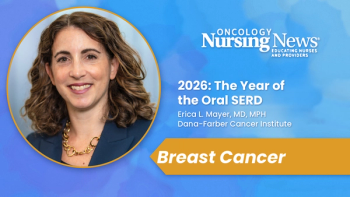
After a run of 2026 oral SERD approvals, Erica L. Mayer, MD, MPH, discusses ESR1 testing and a possible adjuvant role for giredestrant.
Arturo Loaiza-Bonilla, MD, MSEd, explains how artificial intelligence identifies trial-eligible patients, current technology limitations, and why he left academia to close gaps in cancer care.
Artificial intelligence (AI) is increasingly being used to match underserved patients with cancer to clinical trials by identifying eligible candidates who might otherwise be overlooked by traditional screening systems.
While practicing at the University of Miami, Arturo Loaiza-Bonilla, MD, MSEd, frequently treated uninsured and underrepresented patients who met trial criteria yet remained invisible to standard recruitment workflows. “There was nothing that I could do for those patients,” he said. “But I said, ‘We need to do something.’”
That problem followed him to Penn Medicine, where he discovered that even his colleagues — working in the same department, running the same disease areas — didn’t know what studies were open. Not because they didn’t care, he was quick to clarify, but because the incentives weren’t aligned and the time simply wasn’t there. Therefore, he left academia, co-founded Massive Bio, and started building the infrastructure oncology was missing.
Today, Massive Bio’s AI platform completes end-to-end patient characterization and trial matching in as little as 17 seconds, pulling structured data from any US electronic medical record and cross-referencing it against a fully parameterized clinical trial database developed in collaboration with OpenAI. The platform has helped more than 200,000 patients across 17 countries, earned an NCI SBIR grant, and published a prospective evaluation in 3,800 patients.
In a recent episode of The Moonlight Shift, Loaiza-Bonilla also addressed the limits of the technology he helped build. When asked whether AI can fix inequity in clinical trial access, his answer was measured: alert-based matching systems, he noted — including one randomized at Harvard — showed more matches but zero improvement in enrollment. The gap isn’t identification. It’s engagement, education, and the last mile.
On whether AI will make cancer care more equitable: “Jury still out,” he said. “We can do both.”
The Moonlight Shift is available on