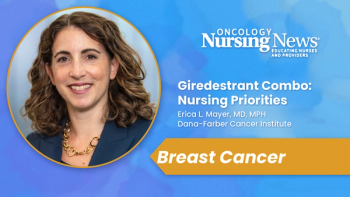
Erica L. Mayer, MD, MPH, explains what the all-oral giredestrant plus everolimus regimen asks of patients and oncology nurses between clinic visits.
After a run of 2026 oral SERD approvals, Erica L. Mayer, MD, MPH, discusses ESR1 testing and a possible adjuvant role for giredestrant.
With the November 16, 2026, FDA approval of giredestrant (Wilserdly) plus everolimus (Afinitor) for ESR1-mutated, estrogen receptor (ER)–positive, HER2-negative advanced breast cancer, oral selective estrogen receptor degraders (SERDs) have become a defining story of the year, and their expansion makes ESR1 testing and familiarity with the drug class essential for oncology nurses, according to Erica L. Mayer, MD, MPH, principal investigator of the phase 3 evERA Breast Cancer trial.1,2
In evERA, the combination reduced the risk of disease progression or death by 62% vs standard endocrine therapy plus everolimus in patients with ESR1 mutations (HR, 0.38; 95% CI, 0.27-0.54).2
Giredestrant follows 2 other 2026 approvals of oral SERD combinations for ESR1-mutated advanced disease:
“A large part of that story has been around the oral SERDs where we've seen multiple approvals just in 2026,” Mayer, director of breast cancer clinical research at Dana-Farber Cancer Institute in Boston, Massachusetts, said in an interview with Oncology Nursing News.
Mayer noted that in the metastatic setting, each of these approvals has been limited to patients whose cancers carry ESR1 mutations. “So a takeaway from that is the importance of performing genomic testing and understanding when ESR1 mutations developed, picking up on that, and then applying the correct therapy if that is found,” she said.
Each of these approvals relies on an FDA-authorized test to identify ESR1 mutations. The Guardant360 CDx assay was approved as a companion diagnostic with camizestrant and with imlunestrant plus abemaciclib, and FoundationOne Liquid CDx was approved with giredestrant.3-5 For nurses, that means coordinating blood-based testing, confirming insurance coverage, and scheduling time to review results with patients.
The FDA is reviewing giredestrant as adjuvant treatment for adults with ER-positive, HER2-negative, stage I to III breast cancer at intermediate to high risk of recurrence, based on the phase 3 lidERA trial, with a decision expected by November 30, 2026.1 Mayer said an early-stage approval would not necessarily be restricted by ESR1 status.
“It is possible in the years ahead that oral SERDs may become a preferred endocrine standard of care across the breast cancer spectrum in both early and advanced disease,” she said.
Integration will take work. “A challenge for us in clinic will be how to integrate the use of adjuvant giredestrant into our existing paradigms for patients with different stages and risk levels of breast cancer, particularly whether there's an overlapping indication with CDK4/6 inhibition,” Mayer said. She added that readouts from other large adjuvant oral SERD trials are expected in the next few years.
1. FDA approves Genentech's Wilserdly (giredestrant), a next-generation oral SERD, for ER-positive, ESR1-mutated advanced breast cancer. News release. Genentech. November 16, 2026. Accessed November 17, 2026. https://www.gene.com/media/press-releases
2. Mayer E, et al. Giredestrant plus everolimus in advanced breast cancer. N Engl J Med. 2026;395(13):1285-1298. doi:10.1056/NEJMoa2602457
3. ONN Staff.
4. Attobrah Q.
5. ONN Staff.