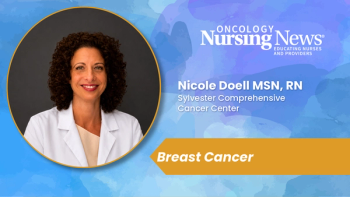
Sylvester's Nicole Doell, MSN, RN, discusses how oncology nurses can support patients with breast cancer emotionally, from diagnosis to survivorship.
Nicole Doell, MSN, RN, of Sylvester explains how nurses can address breast cancer misinformation without judgment and share vetted resources.
Patients with breast cancer often arrive at the clinic having searched online, scrolled through social media, or heard advice from friends and family. Sorting accurate information from inaccurate or unsafe claims has become a routine part of oncology nursing care, and nurses are often the care team members patients reach most easily.
In part 2 of this 2-part Breast Cancer Awareness Month interview, Nicole Doell, MSN, RN, executive director of nursing for ambulatory clinics at Sylvester Comprehensive Cancer Center, part of the University of Miami Health System, discussed how nurses can respectfully address misinformation, share vetted resources, and stay current.
Obviously, with technology at our fingertips, patients have come in, they share this information, whether it be print media, online searches. And our nurses should be listening without judgment, clarifying, again, any of the concerns they're seeing, and also providing clear, evidence-based information from reliable sources, right? So doing this obviously in a respectful way.
The most important thing is listening without judgment, right? Trying to understand and go back to the diverse population that we see. So understanding [the best way] for them to receive information, right? Some really rely heavily on social media, some go through their own searches, some really rely on support groups. So I think the nurses at the heart of it need to really actively listen without judgment. And then when the time is right, they can share whether some of these resources are evidence-based or…maybe it's more opinion-driven, and we, you know, we can talk through that and share that. But also, being an NCI-designated cancer center, we really do have a lot of wonderful resources that we can share with the patients, including websites they could go to.
We have our annual conference that we do to keep our nurses up to date with all things oncology, and then we have specific areas of attention that we do based on the site disease groups. [The] process is really to make our nurses as much subject matter experts within the specialty and working at the top of their scope, so that when they're working within that care team, right, there's a delineation of roles to it as well. And there's really no overlap, right? So the patient's really getting a nurse, they're getting a nurse practitioner, they're getting a provider that's really available to them, not only when they are in our facility, but also when they leave.
Our nurses are the point of contact for our patients. So, you know, our patients leave sometimes with a lot of information. It can be very overwhelming, especially for a new diagnosis. So our patients are always [provided] contact numbers, which are our nurses in the clinic, and they can reach back out, and the nurses can really go through clarifying any needs the patient has, any questions that they have, in a very timely manner, and they are getting that primary care nurse. So it's really specialized care based on patients and specific patient needs.
Previous Oncology Nursing News coverage has outlined