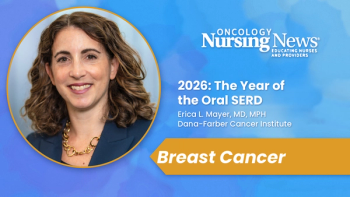
After a run of 2026 oral SERD approvals, Erica L. Mayer, MD, MPH, discusses ESR1 testing and a possible adjuvant role for giredestrant.
Jessica Miles, MS, RN, CNS, outlines how oncology nurses can overcome time, access, and fear of rejection to share practice evidence.
Publishing a practice change does not have to start with a large research study, but it does take support, protected time, and a willingness to ask for help, according to Jessica Miles, MS, RN, CNS, AOCNS, TCTCN, a clinical nurse specialist in oncology and blood and marrow transplant at UC Davis Medical Center.
In part 2 of a 2-part “Onc Nurse On Call” episode, Miles told co–editors in chief Patricia Jakel, RN, MN, AOCN, and Stephanie Desrosiers, DNP, MSN, RN, AOCNS, TCTCN, what helped her publish a stem cell infusion quality improvement project in the Clinical Journal of Oncology Nursing1 and what nurses without those advantages can do.
Miles credited institutional resources first. "I think I benefit so much from being at an academic institution and having resources," she said, citing a nurse scientist at the UC Davis Center for Nursing Science who connected her with a statistician. Nurses elsewhere may find help through a medical school or research office, she said, because "the answer is always no if you don't ask."
An editor-advisor at the journal was equally important. "Having the connection at [CJON] with Tia was so helpful because I wouldn't have known where to start," Miles said. Desrosiers noted that "mentorship is so crucial." Miles agreed: "It'd be very difficult to do all alone." The Oncology Nursing Society has also offered a CJON writing mentorship program that pairs new authors with published nurses.2
"Time and bandwidth is the biggest barrier I see," Miles said. She encourages new nurses to write down questions that come up during a shift so they can return to them later. Measuring clinical outcomes rather than relying on surveys means chart audits and possibly institutional review board approval, which requires protected time that leadership support and unit-based practice councils can provide.
Not necessarily. Since her article appeared, another institution has contacted Miles about replicating her laboratory work, and a colleague at UCSF completed a similar project. Pooling results could build an evidence base so that "we don't each need to do our own mini research project to prove that that's okay," Miles said. Posters and evidence syntheses also move practice forward. In a previous Onc Nurse On Call episode, nurse scientist Jamie S. Myers, PhD, RN, AOCNS, FAAN, similarly
Miles described rejection as part of the process. Having trusted contacts review a submission first helps, she said, but "you miss 100% of the shots you don't take." She encouraged nurses to treat reviewer comments as feedback that strengthens the final product.
For rural nurses, who "might be the only RN in that whole clinic," Miles recommended Oncology Nursing Society resources, message boards, and reaching out to authors they admire. Oncology Nursing News has also offered
1. Miles J, Hoffman L. Implementation of infusion pumps and filtered administration sets for stem cell transplantation. Clin J Oncol Nurs. 2024;28(2):209-213.
2. Pirschel C. How does mentorship help new oncology nurse authors get published? ONS Voice. May 1, 2018. Accessed November 5, 2026.
3. Navigating the complex world of oncology research with Jamie S. Myers. Oncology Nursing News. March 19, 2026. Accessed November 5, 2026.
4. Schulmeister L. Do the write thing. Oncology Nursing News. December 4, 2018. Accessed November 5, 2026.