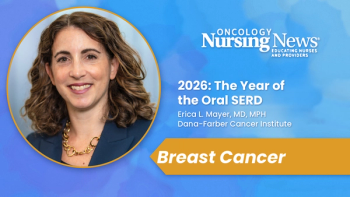
After a run of 2026 oral SERD approvals, Erica L. Mayer, MD, MPH, discusses ESR1 testing and a possible adjuvant role for giredestrant.
Brandon Mancini, MD, MBA, FACRO, explains who may qualify for Pluvicto or Lutathera and how nurses can limit radiation exposure.
As targeted radiopharmaceutical therapies move earlier in the management of metastatic prostate cancer and neuroendocrine tumors, oncology nurses and advanced practice providers (APPs) are increasingly likely to care for patients receiving them, whether in the clinic, the emergency department, or an inpatient oncology unit.
In the first installment of a 2-part interview with Oncology Nursing News, Brandon Mancini, MD, MBA, FACRO, a radiation oncologist at West Michigan Cancer Center and clinical assistant professor in the Department of Medicine at Western Michigan University Homer Stryker M.D. School of Medicine, discussed the clinical signals that should prompt evaluation for radioligand therapy, practical radiation safety precautions for nurses and APPs, and how the longitudinal nature of these treatments is changing collaboration between radiation oncology and medical oncology teams.
On July 31, 2026, the FDA approved lutetium Lu 177 vipivotide tetraxetan (Pluvicto) in combination with androgen receptor pathway inhibitor (ARPI) therapy for adults with prostate-specific membrane antigen (PSMA)–positive metastatic androgen pathway modulation–naïve or –sensitive prostate cancer, previously referred to as metastatic hormone-sensitive prostate cancer.1 Patients are selected using gallium Ga 68 gozetotide (Locametz) or another approved PSMA PET imaging agent.1
The approval was based on the phase 3 PSMAddition trial (NCT04720157), in which 1144 patients were randomly assigned 1:1 to the radioligand plus an ARPI or an ARPI alone. The combination improved radiographic progression-free survival (HR, 0.72; 95% CI, 0.58-0.90; P = .002); median radiographic progression-free survival was not reached in either arm, and overall survival data were immature.1,2 The prescribing information includes warnings for radiation exposure, myelosuppression, renal toxicity, embryo-fetal toxicity, and infertility.1
In neuroendocrine tumors, lutetium Lu 177 dotatate (Lutathera) was approved in January 2018 for adults with somatostatin receptor–positive gastroenteropancreatic neuroendocrine tumors (GEP-NETs).4 The phase 3 NETTER-2 trial later evaluated the agent plus long-acting octreotide as first-line treatment in patients with newly diagnosed grade 2 and 3 advanced GEP-NETs.5
Mancini: For both prostate cancer and neuroendocrine tumors, the FDA-approved treatments for targeted radiopharmaceutical therapy are both for patients with advanced or metastatic disease. So that's kind of a first baseline, where the cancer has to have spread elsewhere for someone to be considered for such treatment.
Now, in prostate cancer, it's particularly exciting because there was just a major FDA approval on July 31st, 2026, that allows it to be considered in the upfront management of kind of metastatic prostate cancer. Meaning, when combined with androgen deprivation therapy and androgen receptor pathway inhibition, the addition of this targeted radiopharmaceutical medicine Pluvicto has been shown to improve patient outcomes. And so really it's just the awareness that that FDA approval had just taken place, and the understanding that patients may benefit from that when it's all said and done.
In neuroendocrine tumor, that's also something that's been around for eight and a half years, and it's something that's typically considered after, again, the cancer has spread. For early or lower-grade lesions, patients are typically on a monthly injection called a somatostatin analog, and patients can be considered for this targeted radiopharmaceutical therapy if their tumor has progressed after being on that sort of injection, typically for many years, actually. What's been new in the last couple of years is that the slightly higher-grade version of neuroendocrine tumor, that's another situation where this targeted radiation medicine called Lutathera can be used in the upfront setting.
And so, what's really happened in the last several years is treatments in the radiopharmaceutical space went from midline or end-of-line type therapies to the beginning. So really, at any juncture of evaluating these patients, I think it's appropriate to at least think about that and to know that these options exist, and inquire as to whether it should be done now or could be evaluated for consideration in that sort of management.
Now, the baseline, as far as patients that qualify, which is important: they need some baseline good blood count numbers, like hemoglobin and platelets and white blood cells, and kidney function and things like that. And those are well documented, well published. But most patients in 2026, they meet all those criteria without any problems. So it's just the awareness these therapies exist, they can be considered in super early stage of the management of metastatic tumors, and that the field continues to evolve. That awareness is very, very important.
Radiopharmaceutical therapies do kind of, for lack of a better phrase, make a patient radioactive for a couple of days following treatment. So typical recommendations are three feet for three days, meaning that patient should try to stay three feet of distance away from people that are closest to them, so typically household contacts and others, as often or as much as possible. Any radiation principle from a radioactive substance perspective is the principle of ALARA: as low as reasonably achievable. So the person that got the radiation medicine, it's okay for them to be radioactive, but other people, really, we should be trying to minimize or eliminate any sort of exposure.
What's super important, and what comes up kind of on a day-to-day basis, is, say a patient had radiopharmaceutical therapy today and needed to go to the emergency department tomorrow, right? So they're interacting with APPs or nurses, or maybe they're admitted to an oncology floor, or they're going to see their oncologist or things like that. Again, the general awareness that these principles are in place, and that we should be able to create distance and create safe spaces where you're not overexposing, or exposing at all, other patients and providers to the radioactivity, is super important.
Now, brief interactions are very, very, very safe, and we typically see very little radiation exposure, even to household contacts that maintain that three feet for three days kind of recommendation.
What's really important is for the neuroendocrine cancers: those patients might have an injection. That monthly injection that I alluded to earlier is typically something that may be continued throughout their radiopharmaceutical therapy journey. That injection is typically done the day after treatment, when that person is radioactive. And so again, it's not that they can't get the injection or they need to completely rearrange schedules, but that while you're in the room explaining the injection, while you're doing any sort of history taking, things like that, the three-foot distance is good, and then just minimizing the time within three feet when it's all said and done. But it's very, very safe. It's just an abundance of caution, and it's making sure when you have a choice, when you have an ability to be that three feet distance, that's very important.
Now, the one caveat would be women that are pregnant or attempting to become pregnant. So if it was a nurse or an APP or provider, typically it's three feet for seven days. So if it's possible for another nurse to take your place in that sort of interaction, knowing that a radioactive patient might be coming in, that would be advisable. But other than that, people should feel more at ease that minimal interactions in that space are very safe, without long-term sequelae that we're aware of.
Typically, in a standard radiation oncology clinic, you may be intensely interacting with a patient for days or weeks, meaning their treatment course might be that SBRT, that one to five treatments, or it might be, like, head and neck cancer could be up to seven weeks of daily Monday-through-Friday treatment. But in radiation oncology, classically, there's kind of that episode of care of a couple of weeks or a few weeks, and then intermittent follow-up, where they might have more intensive follow-up with their oncologist.
What changes in radiopharmaceutical therapy is now, if it's delivered through a radiation oncologist or a theranostics physician, you're interacting with that patient every six weeks for like seven to nine months, and you're typically ordering labs for that patient and following up on them. You're working directly with the oncology team if there's these day-after injections that we talked about, or other things that need to be considered. And so it's more longitudinal management in a radiation oncology clinic, where typically that's a medical oncology thing.
And so I think it's really just creating a treatment team, an algorithm, a treatment journey, and perspective where it fits that unique center, right? An academic center's version of delivering radiopharmaceutical therapy is going to be different than a freestanding center versus a community hospital network, et cetera. But there's definitely more interaction due to the longitudinal care, and so finding the best fit, working with their team members and leadership to create the best patient journey. But a lot more interaction than we typically have seen.
1. FDA approves lutetium Lu 177 vipivotide tetraxetan with androgen receptor pathway inhibitor therapy for metastatic androgen pathway modulation-naïve or -sensitive prostate cancer. News release. FDA. July 31, 2026. Accessed November 16, 2026. https://www.fda.gov/drugs/resources-information-approved-drugs/fda-approves-lutetium-lu-177-vipivotide-tetraxetan-androgen-receptor-pathway-inhibitor-therapy
2. PSMAddition: study of 177Lu-PSMA-617 in men with metastatic hormone sensitive prostate cancer. ClinicalTrials.gov identifier: NCT04720157. Accessed November 16, 2026. https://clinicaltrials.gov/study/NCT04720157
3. ONN Staff. FDA approves Pluvicto for PSMA+ mAPMN/S prostate cancer. Oncology Nursing News. July 31, 2026. Accessed November 16, 2026. https://www.oncnursingnews.com/view/fda-approves-pluvicto-for-psma-mapmn-s-prostate-cancer
4. FDA approves lutetium Lu 177 dotatate for treatment of GEP-NETs. ONS Voice. January 2018. Accessed November 16, 2026. https://www.ons.org/publications-research/voice/news-views/01-2018/fda-approves-lutetium-lu-177-dotatate-treatment-gep
5. Singh S, Halperin D, Myrehaug S, et al. [177Lu]Lu-DOTA-TATE plus long-acting octreotide versus high-dose long-acting octreotide for the treatment of newly diagnosed, advanced grade 2-3, well-differentiated, gastroenteropancreatic neuroendocrine tumours (NETTER-2): an open-label, randomised, phase 3 study. Lancet. 2024;403(10446):2807-2817. doi:10.1016/S0140-6736(24)00701-3