A Columbia nurse scientist shares her takeaways from the 2026 ASCO Quality Care Symposium, from geriatric assessment to care across the age span.
An ONS review presented at EONS19 outlines 7 system-level employer strategies to curb oncology nurse burnout and improve retention.
Employers, not individual nurses, should carry the primary responsibility for oncology nurse well-being, according to a literature review presented at the 19th Congress of the European Oncology Nursing Society (EONS19), held during the ESMO Congress 2026 in Madrid, Spain.1 The review identified 7 areas for employer action that apply across geographic settings, although the authors noted that published evidence on implementing these strategies remains limited.
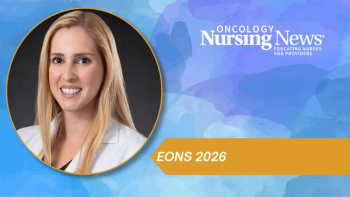
The work was presented by Kathleen Wiley, MSN, RN, AOCNS, director of oncology nursing practice at the Oncology Nursing Society (ONS), with coauthor Kerri Moriarty.
Repeated exposure to suffering and end-of-life decisions raises oncology nurses' risk of emotional exhaustion, moral distress, compassion fatigue, and turnover.1 Wiley said those pressures exist across specialties, but oncology nurses get less recovery time.
“The thing is that with oncology, there's often less rebound time for the next time that an oncology nurse is faced with it,” Wiley said in an interview with Oncology Nursing News. “It could be as soon as the very next room that they walk into, the next chair that they approach or the next phone call they make.”
She added that the
A search of PubMed and CINAHL for articles from 2020 through 2025 yielded 407 and 114 references, respectively, plus 81 from citation searching; 20 titles were retained.1 The 7 recommended areas for employer action were:
On staffing, Wiley said adequacy is about skill mix as much as head count. “I don't mean just having enough bodies on the floor, but do we have a nice balance of experience and novice, certification and not?”
After a patient death or a morally complex event, she described a brief team pause that a charge nurse can call: “Let's take time to acknowledge what we just saw, what we all just endured.” To reduce stigma, leaders should present these resources as expectations of staff, which “helps incorporate them into the culture.”
The authors concluded that more published work on implementation is needed.1 Wiley encouraged nurses to share quality improvement results beyond their units through posters and publications, “so that we can turn gut feelings and kind of common sense practice to really evidence-based, hard to dispute strategies for administrators to implement.”
1. Wiley K, Moriarty K. From burnout to belonging: a global workplace blueprint for oncology nurse well-being. Ann Oncol. 2026;37(suppl):CN83. Presented at: 19th Congress of the European Oncology Nursing Society (EONS19) at the ESMO Congress 2026; October 24-26, 2026; Madrid, Spain.
2. Mitigating compassion fatigue and nurse burnout amid COVID-19. Oncology Nursing News. 2020;14(4). Accessed November 9, 2026.