In 1,071 women diagnosed at 40 or younger, lower income was tied to delayed presentation and younger age to delayed diagnosis.
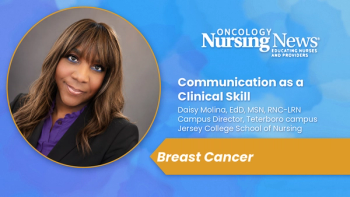
Daisy Molina, EdD, MSN, RNC-LRN, discusses listening, honest reassurance, and lifelong communication skills for nurses facing hard conversations.
Patients may not remember every detail of a breast cancer diagnosis, but they remember how they were treated, according to Daisy Molina, EdD, MSN, RNC-LRN, campus director of Jersey College School of Nursing's Teterboro, New Jersey, campus. For nurses, that makes communication skills as lasting as any clinical skill and something to keep building long after graduation.
In the final installment of a 3-part series, Oncology Nursing News spoke with Molina about how nursing students grow into these conversations, why listening should come before information, why "it's going to be OK" is a phrase to avoid, and how experienced nurses can keep strengthening their communication.
Part 1 of the series covered how communication is taught as a clinical skill, and part 2 addressed how nurses can support caregivers and families after a diagnosis.
This interview has been edited for length and clarity.
This, to me, is something that students have to evolve in the ability of doing. Not anyone walks into this program knowing the right answers, knowing how to communicate. As nursing students, we've all been there. We've made mistakes; we've said the wrong things.
I think it's important to remember that the patient may not remember the details of a diagnosis, but they remember how they're being treated. A lot of times when we do simulations and there's a lot of communication where the patient is frightened or has a lot of questions, I always remind the students that there's a lot of value in the way you communicate with that patient when they're feeling very vulnerable.
One of the things we like to emphasize is to really make space for listening: to not come in there with a whole report. A lot of times, students are anxious and uncomfortable with what they're talking about. When we talk about cancer, let's face it, society looks at cancer as a death sentence. So a lot of times, if the student isn't comfortable with the way they deal with death and with grief, these are difficult conversations to have with their patients.
Throughout the curriculum, we try to create these scenarios and role-play and talk about how we would communicate with these clients. Going back to listening again: make a lot of space for listening. Do not come in there with a bunch of information. Allow the patient to express their fear, their sadness, or their uncertainty.
We've all heard in nursing school: never say to the patient, "It's going to be OK." I think that people say that because they do not know what to say, especially when dealing with [a] breast cancer diagnosis.
We also ask that our students communicate honestly and compassionately. Use very plain language, and if you do not know something, acknowledge that. You're not going to skate around it and pretend you know. Avoid offering reassurance that you cannot support. Patients require that time to process information and revisit conversations if needed.
We want to seek feedback, participate in communication training, and reflect on difficult interactions. Even the experienced nurse can strengthen communication through simulation, peer learning, [and] collaboration. This is something that we want our students to evolve into: to evolve into being effective communicators that can handle these difficult conversations.
We'd like to send the message to our students and future nurses that you want to treat the diagnosis, absolutely, but you never lose sight of the person that's living with it. Include the family appropriately, honor the patient's voice, and remember that compassion and communication is an essential part of providing that quality nursing care.
Molina's point that comfort with death and grief shapes how nurses communicate echoes a broader conversation about the emotional demands of oncology work. At the Association of Pediatric Hematology/Oncology Nurses 2026 conference, Amy C. Haskamp, MSN, RN, PCNS-BC, CPON, CHPPN, FPCN, FAPHON,