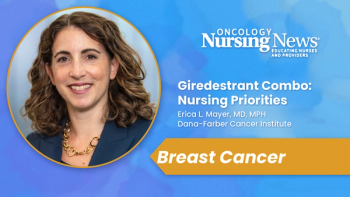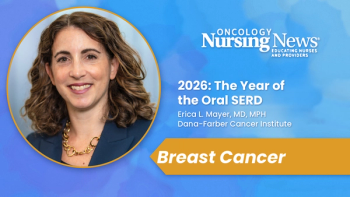
After a run of 2026 oral SERD approvals, Erica L. Mayer, MD, MPH, discusses ESR1 testing and a possible adjuvant role for giredestrant.
Kelsey Martin, AG-ACNP-BC, AOCNP, says new breast cancer approvals in 2026 are bringing targeted treatments to patients earlier and closer to home.
A steady stream of new drug approvals in breast cancer during 2026 is giving patients access to targeted treatments earlier in their disease course and closer to home, according to Kelsey Martin, AG-ACNP-BC, AOCNP, who presented precision oncology updates in breast cancer at the 10th Annual School of Nursing Oncology (SONO), held November 11, 2026, at the New York Hilton Midtown in New York City.1
Martin, a nurse practitioner at Sarah Cannon Research Institute/SCRI Oncology Partners in Nashville, Tennessee, delivered a 20-minute session titled "Precision Oncology Updates in Breast Cancer."1
In an interview with Oncology Nursing News, Martin described a talk focused on how targeted therapies are reshaping treatment across disease settings.
"I'm going to be talking about some precision oncology in breast cancer, how we use targeted medicines, some different updates that we've had in the last year that change how we treat patients in the curative and the metastatic setting," she said.
Asked what stood out from the year, Martin pointed to the volume of new options. "Breast cancer has had so many updates in 2026. We've had, I think, more than 10 FDA approvals of new drugs," she said, adding that the summer brought approvals for new medications and new lines of therapy.
Antibody-drug conjugates (ADCs) have been a large part of that activity. In 2026, the FDA approved fam-trastuzumab deruxtecan-nxki (Enhertu) for 2 early-stage HER2-positive breast cancer indications and approved datopotamab deruxtecan-dlnk (Datroway) for certain patients with metastatic triple-negative breast cancer (TNBC), as Oncology Nursing News previously reported in coverage of
For nurses, that pace means learning new agents, administration schedules, and toxicity profiles as therapies move from clinical trials into routine community practice.
Martin said the practical effect for patients is access. "So it's super exciting for our patients because they can get access to treatments earlier, they can get access to treatments closer to home," she said. "I'm privileged to work at a site that does clinical trials, but not everyone has those."
She noted that many patients are unable to travel to a trial site, and that bringing treatments with demonstrated benefit to community settings near patients' homes is the goal.
Martin has previously discussed the nursing demands that accompany these newer regimens. In an August 2026 interview, she described how
Martin said the meeting's format reflects the breadth of patients that nurses and advanced practice providers (APPs) treat, with attendees hearing about specific diseases, specific drugs, and specific clinical issues from experts across fields.
"So many of us as APPs and as nurses see all types of patients and all types of tumor types, and so being able to kind of hear from different folks that are able to give us even more pearls of wisdom and updates about specific tumor type is super exciting," she said. "So we can hear it all in a condensed version with a lot of different really smart experts in the field."
1. 10th Annual School of Nursing Oncology (SONO): agenda. Physicians' Education Resource. Accessed November 13, 2026.
2. JADPRO Live 2026 takeaways for oncology nurses and APPs. Oncology Nursing News. October 27, 2026. Accessed November 13, 2026.
3. Biese A. Kelsey Martin, APRN, AOCNP, discusses frontline ADCs and managing TNBC care. Oncology Nursing News. August 30, 2026. Accessed November 13, 2026.