

A 10-year study of 3,477 patients reveals focal therapy offers high survival and low metastasis for localized prostate cancer with few side effects.
A 10-year study of 3,477 patients reveals focal therapy offers high survival and low metastasis for localized prostate cancer with few side effects.

Simone Payette-Capone, RN, discusses balancing protocol with patient care, managing GU trial logistics, and the research nurse's role as a "detective."
NATCO Pharma receives tentative U.S. FDA approval for a generic version of the PARP inhibitor olaparib (Lynparza) for oncology indications.
Kevin Brigle, PhD, ANP, discusses frontline quads, managing toxicities of bispecifics, and the evolving role of nursing in multiple myeloma treatment.

Linda Casey, RN, shares essential strategies for oncology nurses to protect vulnerable patients from the clinical risks of wildfire smoke exposure.

Drs. Sledge and Pastorini discuss how AI-powered molecular profiling corrected a misdiagnosis and the vital "early warning" role of oncology nurses.
FDA approves gedatolisib for HR+/HER2- breast cancer. Learn about the VIKTORIA-1 trial, dosing, and nursing strategies for managing stomatitis.
FDA approves gedatolisib with fulvestrant for adults with HR+/HER2- metastatic breast cancer following endocrine therapy progression.
The FDA has granted traditional approval to selpercatinib for adult and pediatric patients with RET fusion-positive solid tumors post-progression.
Czarina Cecilio, BSN, RN, shares roundtable insights on toxicity management, injection techniques, and the critical role of nursing education.
FDA approves SC isatuximab-irfc with the CirCLIQ on-body injector, streamlining multiple myeloma care and reducing nursing burden.

The WHO 2026 report warns of a global cancer surge by 2050, highlighting critical inequities and the need for people-centered oncology nursing care.
Donna Berizzi discusses how LeanTaaS capacity management tools reduce nurse burnout by optimizing outpatient workflows and improving patient access.
FDA expanded pembrolizumab and enfortumab vedotin-ejfv for all surgery-eligible adults with muscle-invasive bladder cancer following positive trial data.
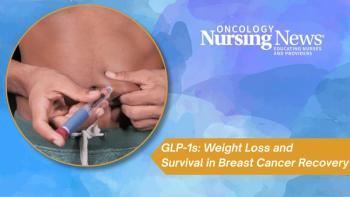
Experts explore the clinical promise, nursing implications, and access barriers of GLP-1s in cancer care.
FDA approves subcutaneous isatuximab-irfc for multiple myeloma indications, offering an efficient delivery alternative to intravenous administration.
FDA approves Ennumo (pegfilgrastim-pccg), a biosimilar to Neulasta, providing a new option for oncology nurses to manage chemotherapy-induced neutropenia.

Dr. Rodney Haring discusses the 2026 AACR Cancer Disparities Report and the critical role of oncology navigators in tribal and rural health equity.
ESMO GI 2026 data show patients under 50 receive more aggressive therapy yet face poorer survival, suggesting EOCRC is a distinct biological entity.
Study finds 86.5% of gastric/GEJ patients completed surgery after neoadjuvant chemo, significantly improving survival over those who did not.

Long-term data show watch-and-wait is viable for rectal cancer, with most regrowths salvageable despite adverse baseline MRI features.

Melissa Baker discusses SOPs in transplant care, gene therapy for sickle cell, and the essential role of nurses in clinical strategy and care planning.
A real-world study presented at ESMO GI shows fruquintinib is effective in mCRC, with the best outcomes in the third-line setting.

Oncology nurse Kerry Mann details the protocols and patient-centered strategies for bringing advanced precision medicine to local community clinics.

Pamela Plasket, RN, discusses the evolving role of oncology nurses as lung cancer patients survive longer on advanced therapies like BiTEs.

Oncology nurse navigator Diane Stanaway discusses photosensitivity, new sunscreen innovations, and debunking common myths for patients and survivors.
Maite San Miguel and a new survey highlight how specialized training and clinical autonomy are vital for optimizing multiple myeloma outcomes.
The FDA approved Tregzi, a precision-engineered cell therapy, to improve chronic GVHD-free survival in adults undergoing allogeneic transplant.

PROSPER data reveal that mogamulizumab provides rapid, sustained relief from skin symptoms and improves sleep for patients with MF and SS.
The FDA approved Azurity’s Aprepitant Injectable Emulsion, a polysorbate-80-free, ready-to-use IV option for preventing chemotherapy-induced nausea.