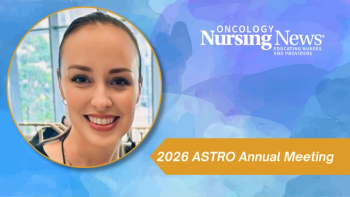
ASTRO 2026 presenter Kayla Kafka-Peterson details an Adapt-Adopt-Build model to bridge global brachytherapy nursing gaps and standardize perioperative care.
At ASTRO 2026, Dr. Mishaal Munir details how nurse-led triage workflows and prompt symptom escalations improve care for breast cancer brain metastases.
At the American Society for Radiation Oncology (ASTRO) 2026 Annual Meeting, radiation oncology researchers highlighted the essential role of nursing workflows in optimizing outcomes for complex solid tumors.
In an on-site interview with Oncology Nursing News, Mishaal Munir, MD, MBBS, BSC, Postdoctoral Research Fellow in Radiation Oncology at Miami Cancer Institute, Baptist Health South Florida, in Miami, detailed how nurse-led triage protocols expedite care for patients with breast cancer brain metastases.
Presenting real-world survival data regarding the timing of intracranial radiotherapy in breast cancer brain metastases, Munir emphasized that frontline oncology nurses serve as the primary link between early neurological symptom detection and timely physician intervention.
Brain metastases represent a high-acuity complication in advanced breast cancer, requiring prompt multidisciplinary assessment. According to Munir, frontline nurses occupy a critical clinical position that enables early identification of subtle disease progression or treatment toxicity.
"I think the nurses are the first clinicians who actually get to know the symptoms of the patients, like specifically if the patient has had any change in the neurological symptoms whether it's some sort of headache, seizures or anything of that sort, they're the first ones to know,” she said.
When neurological changes occur, standard appointment intervals can introduce unnecessary treatment delays. Munir stressed that empowering nurses to escalate concerns directly to attending physicians accelerates clinical evaluation.
In addition to acute escalation, optimizing routine call-back workflows ensures continuous patient monitoring throughout systemic and radiation therapies. Munir noted that transitioning from fixed follow-up schedules to responsive triage protocols improves patient safety.
"They could improve that in a way that just don't call the patient at a regular follow-up rather than just identify these features or symptoms and just call the patient there and then," Munir observed.
Reorganizing care coordination around immediate symptom recognition ultimately enhances surveillance and minimizes treatment gaps across oncology subspecialties.