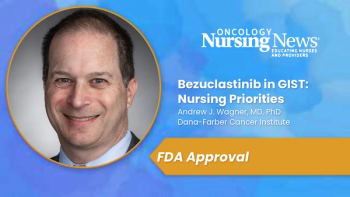
Andrew J. Wagner, MD, PhD, of Dana-Farber explains liver monitoring, dose adjustments, and early patient contact with the new GIST regimen.
Dana-Farber's Andrew J. Wagner, MD, PhD, explains why KIT resistance mutations stalled progress after imatinib and what the new combination changes.
The FDA approval of bezuclastinib (Ekitna) plus sunitinib (Sutent) for adults with advanced gastrointestinal stromal tumors (GIST) previously treated with imatinib (Gleevec) is the first new second-line option since sunitinib was approved in January 2006, and the first new GIST therapy since ripretinib (Qinlock) in May 2020.1,2,3
"It's really exciting that we now have a new drug combination approved for the first time in 20 years for the second line or later treatment of metastatic gastrointestinal stromal tumor," Andrew J. Wagner, MD, PhD, deputy chief medical officer and a senior physician in the Sarcoma Center at Dana-Farber Cancer Institute, said in an interview with Oncology Nursing News.
Imatinib has been approved for GIST since 2002, followed by sunitinib in 2006, regorafenib (Stivarga) in 2013, and avapritinib (Ayvakit) and ripretinib in 2020.3 Wagner explained that resistance biology has limited each of these agents.
"What we understand about GIST is that most of the tumors are driven by mutations in the KIT gene, which inappropriately turn on the protein KIT that leads to uncontrolled cell signaling," he said. "And imatinib, which is standard first-line treatment, can turn that off, but resistance mutations very commonly occur after a couple of years."
"Within a patient, different tumors might have different resistance mutations," Wagner added. "And any of our approved drugs, sunitinib, regorafenib, ripretinib, only inhibit a subset of those resistance mutations. So what this combination of bezuclastinib and sunitinib can do is safely inhibit a broader spectrum of resistance mutations."
In the phase 3 PEAK trial (NCT05208047), which Wagner presented at the 2026 American Society of Clinical Oncology Annual Meeting, median progression-free survival was 16.5 months with the combination vs 9.2 months with sunitinib alone (HR, 0.50; 95% CI, 0.39-0.65; P < .0001) among 413 patients.1,4 The objective response rate was 46% vs 26%, and the label carries a boxed warning for hepatotoxicity.1
"Even more impressive was the improvement with the combination. So this really dramatically controlled the disease for a much longer period of time than sunitinib did," Wagner said, adding that the sunitinib arm also outperformed historical controls.
Overall survival data remain immature, and Wagner noted that crossover may blunt any difference. "I actually hope it doesn't have a big impact on that because we did cross patients over if they had progression on sunitinib to the combination of sunitinib and bezuclastinib," he said. "So hopefully we're able to rescue those patients that started on sunitinib and improve their outcomes with the combination as well."
Among 128 patients who crossed over, median PFS was 7.4 months on the combination vs 5.7 months on prior sunitinib, with an objective response rate of 29.7% vs 20.3%. Grade 3 or higher treatment-related adverse events occurred in 39.1% of crossover patients.5
Wagner pointed to a faster pace of drug development. "These findings take time to develop, but we're accelerating that pace as we're learning more about the mechanisms," he said. Given the rarity of the disease, coordination with experienced sarcoma teams remains essential, a theme highlighted in previous
1. FDA approves bezuclastinib in combination with sunitinib for advanced gastrointestinal stromal tumors. US Food and Drug Administration. November 24, 2026. Accessed November 24, 2026. https://www.fda.gov/drugs/cancer-approvals/fda-approves-bezuclastinib-combination-sunitinib-advanced-gastrointestinal-stromal-tumors
2. FDA approves ripretinib for advanced gastrointestinal stromal tumor. US Food and Drug Administration. May 15, 2020. Accessed November 24, 2026. https://www.fda.gov/drugs/resources-information-approved-drugs/fda-approves-ripretinib-advanced-gastrointestinal-stromal-tumor
3. Kumar V, Doros L, Thompson M, et al. FDA approval summary: ripretinib for advanced gastrointestinal stromal tumor (GIST). Clin Cancer Res. 2023;29(11):2020-2024. doi:10.1158/1078-0432.CCR-22-2400
4. Wagner AJ, Trent JC, Tap WD, et al. Primary results of the phase 3 PEAK study of bezuclastinib + sunitinib vs sunitinib monotherapy in advanced gastrointestinal stromal tumors (GIST). J Clin Oncol. 2026;44(suppl 16):11500. doi:10.1200/JCO.2026.44.16_suppl.11500. Presented at: 2026 ASCO Annual Meeting; May 29-June 2, 2026; Chicago, IL.
5. Crossover to bezuclastinib plus sunitinib improves disease control in pretreated GIST. Targeted Oncology. November 15, 2026. Accessed November 24, 2026. https://www.targetedonc.com/view/crossover-to-bezuclastinib-plus-sunitinib-improves-disease-control-in-pretreated-gist
6. Sarcoma Awareness Month: the critical role of multidisciplinary nursing. Oncology Nursing News. July 22, 2026. Accessed November 24, 2026. https://www.oncnursingnews.com/view/sarcoma-awareness-month-the-critical-role-of-multidisciplinary-nursing