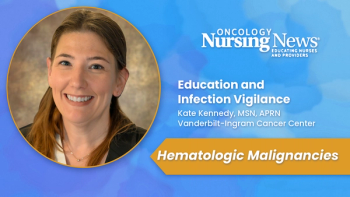
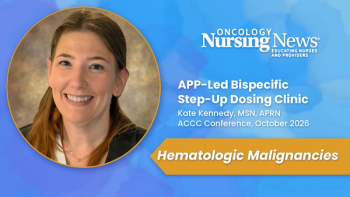
Kate Kennedy, MSN, APRN, explains how Vanderbilt-Ingram's award-winning APP clinic moved bispecific step-up dosing out of the hospital.
At the 2026 National Summit on Hematologic Cancers, Kate Kennedy, MSN, APRN, flagged decisions where guidelines give nurses and APPs little direction.
Choosing between B-cell maturation antigen (BCMA)–directed chimeric antigen receptor (CAR) T-cell therapy and bispecific antibodies, supporting patients on oral oncolytics, and using frailty assessments without delaying care are 3 gray zones where oncology nurses and advanced practice providers (APPs) have a role, according to Kate Kennedy, MSN, APRN, ACNP-BC, AOCNP.
Kennedy, outpatient malignant hematology APP team lead at Vanderbilt-Ingram Cancer Center in Nashville, Tennessee, served on a panel on sequencing bispecific antibodies and CAR T-cell therapy and comoderated a session on oral oncolytics and frailty at the 2026 National Summit on Hematologic Cancers. The meeting, held October 16-17, 2026, was themed "Defining the Standard Where the Guidelines End" and built around case-based sessions where evidence is limited.1
Ciltacabtagene autoleucel (Carvykti) is approved after at least 1 prior line of therapy for lenalidomide-refractory multiple myeloma, based on the phase 3 CARTITUDE-4 trial (NCT04181827).2 In March 2026, teclistamab (Tecvayli) plus daratumumab and hyaluronidase-fihj (Darzalex Faspro)
"We have now CAR T and bispecific antibodies both available in the second line for myeloma, but they're both BCMA targeting," Kennedy said. "So how do you choose that this person is going to get a BCMA-targeting CAR T versus a BCMA bispecific antibody?"
In her practice, Kennedy said, APPs may raise these questions, but "ultimately it's the physician who's making the final call." She compared the dynamic to a line from the film My Big Fat Greek Wedding: "We're the neck, but they're the head." That can mean asking, "Are you sure you want to use BCMA, a BCMA bispecific here when they haven't seen CAR T? 'Cause they might really be a good candidate for CAR T right now."
Patient priorities also shape the choice. CAR T-cell therapy is a more defined course of treatment, Kennedy explained, whereas with bispecific antibodies, "we have no data to stop it," she said. Her team has published work on extending dosing intervals. "So what kind of things matters to the patient? Like, are they somebody who's comfortable coming off of treatment?"
Kennedy co-moderated the oral oncolytics session with Lindsay Adkins, MSN, FNP-BC, BMTCN, of the Sarah Cannon Transplant and Cellular Therapy Program. "Just because it's oral, it doesn't mean it's easy," Kennedy said. "Like just because it's oral doesn't mean it doesn't have side effects. And just because it's oral doesn't mean that the patients are taking it."
One case involved a young patient whose insurance technically covered her drug, but at nearly $8,000 a month, after a manufacturer assistance program closed to insured patients, Kennedy said.
On adherence, Kennedy said wording matters. "Hey, you're taking your meds, right? You're gonna get a very different answer than if we say, tell me how you're taking your meds every day, or how many missed doses have you had in the last month, just assuming that there are going to be missed doses."
A panelist from the University of North Carolina described a pharmacist-driven program that flags patients using an outside specialty pharmacy as higher risk for added support.
Frailty assessments can help optimize patients before transplant or identify those for whom transplant may not be appropriate, Kennedy said, but they may also delay definitive care to the point that clinicians "miss our window of opportunity." She added, "I don't think we have an answer. So that's a big gray zone."