



Lung Cancer
Latest News
Advertisement
Latest Videos





























































Advertisement
More News
Panelists discuss how a 48-year-old fitness instructor with ALK-rearranged stage IV lung cancer and bone metastases was successfully treated with alectinib, experiencing manageable adverse effects while returning to modified teaching activities.

The investigational BET inhibitor is being investigated combined with abemaciclib or cisplatin/etoposide in NUT carcinoma in 2 clinical trials.
Panelists discuss how managing amivantamab-related adverse events such as leg edema requires understanding of underlying mechanisms (hypoalbuminemia) and may benefit from albumin infusion, dose holds, or consultation with specialists for severe cases such as infected scalp wounds.
Panelists discuss how the COCOON study’s advanced dermatologic prophylaxis protocol, including systemic antibiotics and topical treatments, can reduce skin toxicities by 50% in patients receiving amivantamab plus lazertinib therapy.

Most patients demonstrated at least partial response to tarlatamab in a real-world population with extensive-stage small cell lung cancer.
Panelists discuss how comprehensive patient education about expected adverse effects, combined with prophylactic measures including dexamethasone premedication and dermatologic support, helps patients successfully tolerate amivantamab plus lazertinib therapy while maintaining treatment adherence.
Panelists discuss how real-world experience with amivantamab plus lazertinib has shown remarkable responses consistent with trial data, including effectiveness in challenging cases such as leptomeningeal disease, with manageable adverse effects when proper prophylactic measures and patient education are implemented.
Sunvozertinib has received accelerated approval for use in advanced or metastatic non–small lung cancer harboring EGFR exon 20 insertion mutations.

Oncologic therapies approved in June included indications in genitourinary, lung, hematologic, and head and neck cancers.

Anlotinib combined with immune checkpoint inhibitors may benefit patients with extensive-stage small cell lung cancer treated with prior immunotherapy.
Panelists discuss how both amivantamab plus lazertinib and osimertinib-based regimens show good central nervous system (CNS) activity for patients with baseline brain metastases, with treatment choice influenced more by patient-specific factors such as bleeding risk and anticoagulation contraindications than by CNS efficacy differences.
Zirconium-89–labeled BMS-986279 demonstrated tumor uptake in fuc-GM1–positive lesions in patients with ES-SCLC.

The NCCN has added taletrectinib to its recommendations for use in all lines of treatments for non–small cell lung cancer harboring ROS1 mutations.

Dato-DXd Greenlit by FDA for Previously Treated EGFR-Mutated NSCLC
Published: | Updated:
Dato-DXd was granted accelerated approval for use in adults with EGFR-mutated NSCLC after EGFR-targeted therapy and platinum-based chemotherapy.
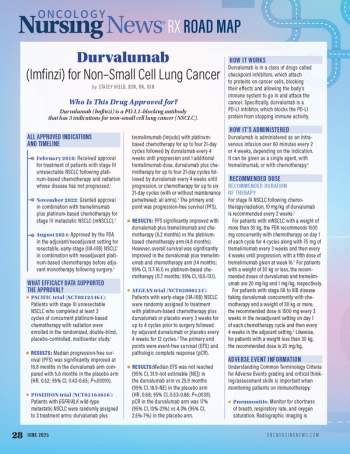
Read Stacey Hield, BSN, RN, OCN's recommendations for the best use of durvalumab in non–small cell lung cancer.

Oncology nurses can play a key role in educating patients and supporting clinical trial participation for this new treatment option.

Nivolumab plus chemotherapy significantly improved OS vs chemo alone in resectable NSCLC, per updated CheckMate-816 findings.

The tyrosine kinase inhibitor taletrectinib has been approved for use in patients with ROS1-positive non-small cell lung cancer.

A molecular assay identified patients with non–small cell lung cancer most likely to benefit from adjuvant chemotherapy, leading to prolonged survival.

Tarlatamab prolonged both overall and progression-free survival in the treatment of small cell lung cancer, backing it as a second-line standard of care.

COCOON skin care led to fewer or milder dermatologic symptoms with amivantamab/lazertinib vs standard care in patients with EGFR+ advanced NSCLC.

The oral TKI sevabertinib has been granted priority review for use in patients harboring HER2 mutations in non-small cell lung cancer.

The VENTANA MET (SP44) RxDx Assay is now FDA approved to identify patients with NSCLC eligible for telisotuzumab vedotin.

First-line maintenance therapy with lurbinectedin plus atezolizumab has the potential to become a new standard of care in extensive-stage small cell lung cancer.

The agent is currently being evaluated as both monotherapy and in combination with atezolizumab in patients with extensive stage SCLC in an ongoing, global phase 1 trial.
Advertisement
Advertisement
Trending on Oncology Nursing News
1
Patient Safety First: How a CNS Bridges Oncology Research and the Bedside
2
Making Innovation Meaningful: Enabling Personalized Care in Multiple Myeloma
3
FDA Grants Accelerated Approval to Dostarlimab in dMMR Rectal Cancer
4
Male Breast Cancer: Warning Signs, Biology, and Genetic Testing
5